Flow Matching in Robot Action Generation
Swapping Gaussian noise for recent robot history cuts sampling to one step.
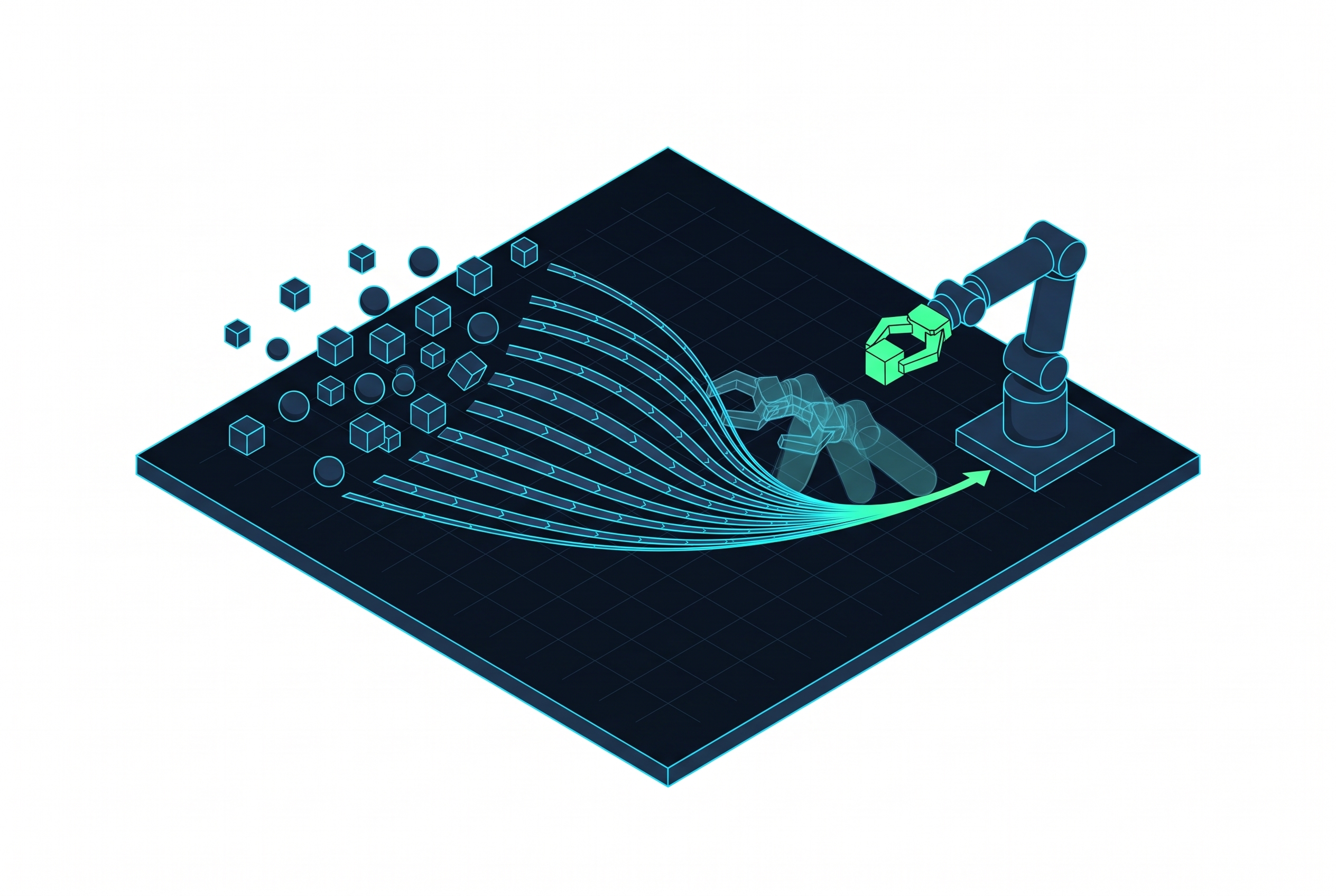
Flow matching has become the dominant framework for robot action generation because its straighter transport paths combine expressive action modeling with faster inference. Yet real-time control demands more than efficient paths. The next advance is to shorten the transport itself, replacing uninformative Gaussian starting points with recent robot history so that policies shift from reconstructing actions from noise to learning the change from past to future.
Why flow matching displaced diffusion as the standard action generation framework
Both diffusion and flow matching learn a transport between distributions, but the geometry of that transport changes the cost of generation. Flow matching with linear interpolation produces nearly straight trajectories from source to target, while diffusion paths curve significantly. Straighter paths need fewer numerical integration steps. An ordinary differential equation integrator can therefore traverse them accurately with fewer function evaluations, or NFE, reducing inference latency without giving up the ability to represent complex action distributions.
Robot policies need that expressive power because there can be quite different ways to move that succeed at the same task. A policy must model each of those options and keep them from collapsing into a single averaged motion. Physical Intelligence’s π₀ (2024) crystallized this combination of precision and multimodal modeling by placing a separate flow-matching action expert on top of a vision-language model backbone. The action expert generates continuous actions, especially for high-frequency dexterous tasks. Its practical advantage follows directly from the geometry, since fewer evaluations leave more time for the next prediction inside the control loop.
Why low latency is non-negotiable in real-time robot control
Robotic manipulation requires control loops at 50–100 Hz for smooth, stable trajectories. Prediction latency directly limits the achievable replanning rate because the prediction call sits inside that loop. Speed is therefore a constraint. Even the best vision-language-action models, or VLAs, still need several inference steps per action, leaving an order-of-magnitude gap between how fast policies generate actions and the control frequencies that manipulation needs.
π₀ and π₀.5 illustrate why that gap persists despite flow matching’s geometric advantage. Each action chunk needs approximately ten action-expert evaluations in sequence to integrate the learned velocity field, so action generation takes up most of the model’s total latency. Engineers must check whether the full sampling process fits the control budget, as well as whether flow matching is faster than diffusion. World-action models, or WAMs, make that question harder because they generate future visual states as well as actions and must do work for both modalities at each sampling step.
What multi-step Gaussian sampling costs in practice
Standard flow-matching policies draw a sample from a fixed Gaussian prior at the start of every action-generation call. That source contains no information about recent execution, so the model must transport an uninformative sample into the target action distribution. A straight path does not eliminate that distance. Even when the route is geometrically direct, the statistical separation between noise and useful actions can require many function evaluations to preserve accuracy.
The source choice also affects what the model must learn during training. Δ-flow matching identifies slow convergence in π₀.5 as part of the cost of learning from a fixed Gaussian source, rather than treating inference latency as an isolated deployment problem. Transport geometry and the choice of source are separate design decisions. Flow matching can use a prior other than a Gaussian prior. That convention comes from earlier generative modeling, and retaining it discards temporal structure that robot execution already provides.
How replacing the Gaussian prior with history-informed starting points shortens the transport
Consecutive robot actions have strong temporal continuity, making recent execution history a better approximation of the next action chunk than Gaussian noise. A history-informed source exploits that proximity. Instead of learning the full transformation from noise to action, the policy learns a smaller residual from recent behavior to the future. This changes the role of history from information that guides generation to the distribution from which generation begins.
Action-to-Action Flow Matching (A2A, RSS 2026) embeds recent proprioceptive action history into a high-dimensional latent space and uses that embedding as its source. Its architecture differs from earlier warm-start approaches because it turns proprioceptive history from a static conditioning signal into a dynamic source distribution. A2A reports inference latency below 1 ms, with a time of 0.56 ms when it uses a single step. That fits within the budget for 50–100 Hz control. Its abstract also reports greater robustness to visual perturbations and improved generalization to unseen configurations, indicating benefits beyond sampling speed.
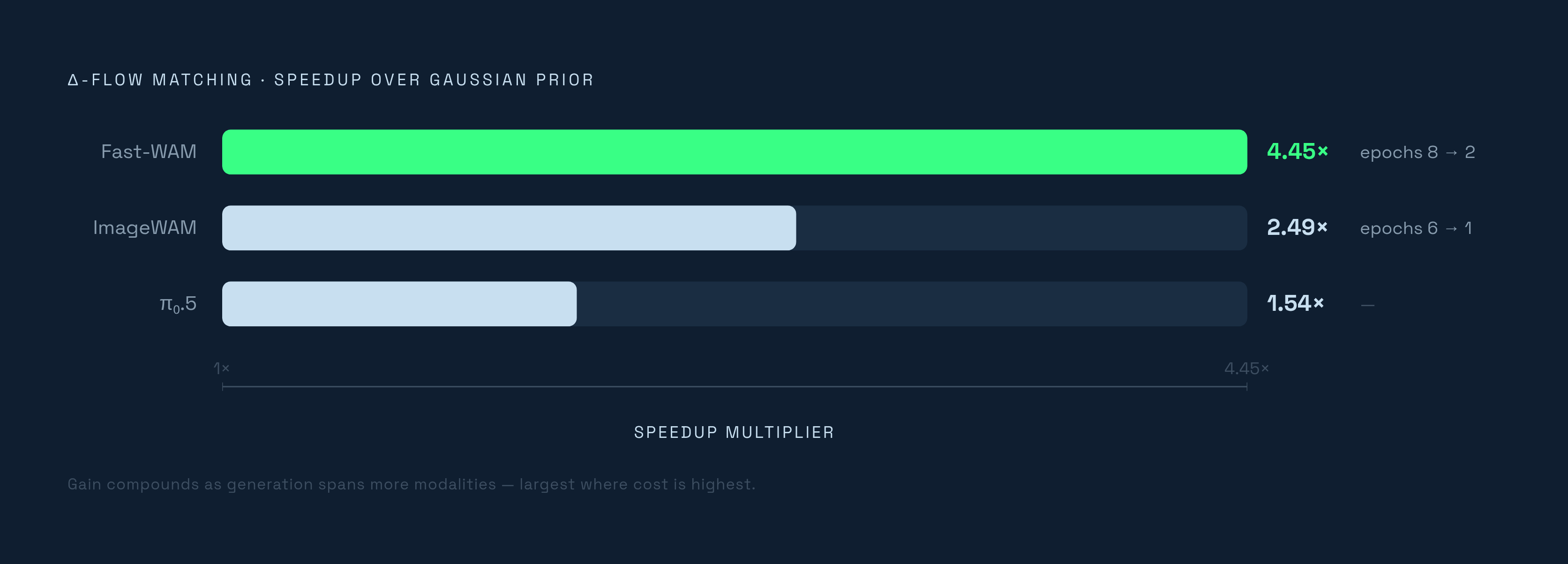
Δ-Flow Matching (October 2026, MARS Lab, Nanyang Technological University) instead constructs its source directly from recent history with mild Gaussian perturbation. The model learns the residual change Δ from the history to the future. Its single-step inference produces speedups of 1.54× for π₀.5, 2.49× for ImageWAM, and 4.45× for Fast-WAM relative to ten-step Gaussian sampling. Training convergence improves as well. On LIBERO, ImageWAM reduces the epochs needed to reach target success from six to one, while Fast-WAM reduces them from eight to two.
Δ-flow also reports substantially less action jerk than one-step Gaussian sampling, improving smoothness across chunk boundaries. Its inference-time replacement of the Gaussian action source with action history can be applied to pretrained WAM policies without retraining, preserving task success with a single sampling step. Whereas A2A learns a latent embedding of proprioceptive sequences, Δ-flow perturbs history directly, giving two distinct implementations of an informative starting distribution.
Other active strategies for reducing inference steps without changing the source distribution
Prior replacement addresses the origin of the transport, while other acceleration methods change how that transport is executed or learned. SnapFlow (2026) uses self-distillation to adapt a pretrained flow-matching VLA to one-step action generation. Its inference consistency loss is indispensable for enabling single-step inference, although the method sacrifices some flexibility compared with vanilla flow matching. Distillation therefore changes the learned generation procedure. It need not replace the Gaussian source to reduce the number of evaluations.
ProbeFlow (2026) takes a training-free approach, dynamically scheduling integration steps for each inference call. On MetaWorld, it accelerates action decoding by 14.8×, reducing average steps from N=50 to 2.6, and cuts end-to-end system latency by 2.8× without compromising manipulation success rate. Other training-free step reductions lower SmolVLA prediction latency by more than half. Step reduction combined with masked-prefix elimination lowers π₀.5 prediction latency by a similar margin, also without retraining.
Distillation and adaptive scheduling reduce the required evaluations while leaving the Gaussian prior intact, whereas history-informed sources reduce the transport the sampler must perform. These approaches can be used together. Their trade-offs do not establish a universal winner.
The frequency-structure problem that standard flow matching ignores in action chunks
Faster generation does not by itself produce temporally consistent trajectories. Robot actions contain low-frequency components that describe global motion trends and higher-frequency components that encode local corrections, with energy distributed unevenly across those components. Standard chunk-based flow matching instead generates actions in temporal coordinates, leaving the network to learn dense cross-timestep couplings implicitly. Frequency coordinates offer a more compact, interpretable representation of that structure. Leaving out that structure adds to temporal jitter and high-frequency oscillations, especially at chunk boundaries.
The Open X-Embodiment dataset spans control frequencies from 3 Hz for RT-1 to 50 Hz for ALOHA, while standard flow-matching policies generate chunks at a fixed frequency without explicitly preserving that frequency information. The mismatch makes heterogeneous demonstrations harder to use robustly. A policy must account not only for which actions appear in a sequence, but also for the temporal scale at which those actions were recorded.
Frequency-Aware Flow Matching (FAFM, June 2026) transforms discrete action sequences into frequency coordinates using the Discrete Cosine Transform. It performs flow matching over the resulting coefficients and reconstructs continuous actions through cosine basis expansion. A smoothness constraint regularizes the first-order temporal derivative to suppress high-frequency errors. FAFM reports improvements in success rate, motion smoothness, convergence speed, and robustness to mixed-frequency input, with validation on LIBERO and a real Franka robot. Its limitation is equally specific, since it is less effective for intrinsically high-frequency or impulsive actions such as sharp jumps or percussive interactions.
FreqFM (September 2026, AGIBOT) makes frequency an explicit conditioning dimension throughout the generation pipeline. It matches the source distribution to the target power spectrum, adaptively balances the training objective across frequencies, and constrains guidance residuals per frequency. The VLA backbone does not need to change. FreqFM reports a 9.3-point gain on LIBERO-Plus, consistent improvements across LIBERO, LIBERO-Plus, and VLA-Arena, and effectiveness on six real-robot tasks. Its pipeline-wide conditioning complements FAFM’s emphasis on temporal consistency and mixed-frequency robustness.
Geometric constraints that Euclidean flow matching cannot handle for end-effector control
Temporal structure is not the only structure an action representation must respect. End-effector control uses 6-DoF poses that combine position and orientation on SE(3), with orientation belonging to the non-Euclidean space SO(3). Ordinary Euclidean linear interpolation can leave the rotation manifold. The resulting trajectory is not a valid sequence of poses, even if the numerical transport is fast and smooth.
In work published in IEEE Transactions on Robotics in 2025, Ding et al. tackle this limitation with Riemannian Flow Matching Policy (RFMP) and its more robust form, Stable Riemannian Flow Matching Policy (SRFMP). These methods perform flow matching directly on Riemannian manifolds, including SE(3), so the learned visuomotor policies respect geometric constraints. Their formulation supports both Euclidean and pose-valued policies. This work is separate from prior replacement and frequency-aware generation, but shows where the structure of Euclidean approaches, including π₀ and π₀.5, falls short for end-effector pose control.
Systems-level hazards that emerge when flow matching VLAs are deployed at scale
Global timestep injection can invalidate KV-caching in iterative flow-matching VLAs. Transformer inference ordinarily uses cached keys and values to reuse attention computations across autoregressive steps, but the global timestep signal changes with each function evaluation during sampling. That change breaks the basis for cache reuse. The resulting choice is between slow O(N²) recomputation at each step and mathematically incorrect reuse of cached values.
The Reflex framework (2026) addresses this incompatibility through a Timestep-Invariance Property. The issue nevertheless remains an open systems-engineering challenge at deployment scale, distinct from the choice of sampler or source distribution. Algorithmic acceleration cannot alone resolve an invalid caching assumption. Deployment also involves RL fine-tuning, which adds to the work of fitting the parts together as policy design grows more complex.
Where the frontier is heading: world-action models and the compounding cost of Gaussian priors
ImageWAM and Fast-WAM extend flow matching from action prediction to joint generation of future visual states and actions. With a Gaussian source, training must learn transports from pure noise for both branches, and inference must evaluate both branches at every sampling step. The starting distribution thus affects how the model scales as it generates more modalities, as well as how fast it decodes actions.
Δ-flow’s larger speedups in WAMs than in π₀.5 are consistent with history-informed sources becoming more valuable as generation grows more complex. Its WAM convergence results also suggest that the shorter transport makes the visual branches easier to learn. That makes prior replacement relevant to training as well as deployment. However, those results do not settle how the other advances in flow matching should fit into a joint world-and-action policy.
Several integration questions remain open. Efficient samplers developed for actions may not retain their effectiveness on the visual branch, and a unified WAM still has to handle cross-embodiment frequency heterogeneity. It is also unresolved whether Riemannian and frequency-aware extensions can be composed with history-informed priors in a single policy. As RL fine-tuning becomes part of policy design, these advances still need to be brought together in a way that keeps their gains in speed, temporal consistency, and geometric validity.
Sources
- 𝚫 Flow Matching for Robot Foundation Models
- Frequency-Conditioned Flow Matching for Vision-Language-Action Models
Provided FreqFM's frequency-conditioning design and its LIBERO-Plus results.
- $\Delta$ Flow Matching for Robot Foundation Models
Supplied the Δ-Flow Matching speedups, convergence epochs, jerk reduction and the history-informed source idea.
- Frequency-Aware Flow Matching for Continuous and Consistent Robotic Action Generation
Described FAFM's DCT-based frequency coordinates, smoothness constraint, validation and limitations.
- Action-to-Action Flow Matching
Supplied A2A's action-history latent source, sub-millisecond latency, and robustness claims.
- SnapFlow: One-Step Action Generation for Flow-Matching VLAs via Progressive Self-Distillation
Covered SnapFlow's self-distillation approach to one-step action generation and its trade-offs.