Contact Physics Fidelity in Robot Manipulation Simulators
Simulators' contact physics shortcuts cause predictable.
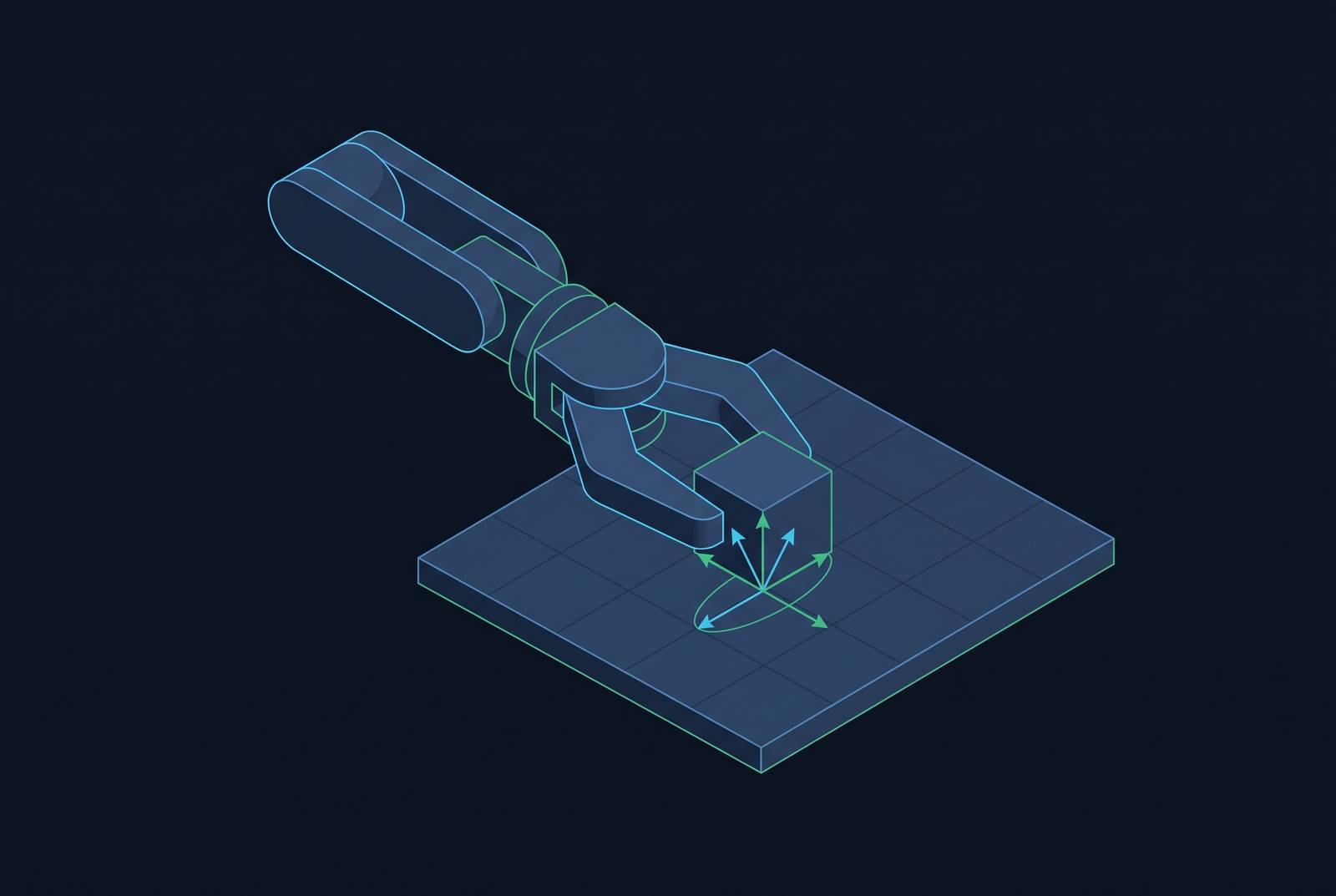
Contact physics fidelity in robot manipulation simulators is not one setting a researcher tunes and forgets. It is a stack of separate problems, friction modeling, soft-body deformation, tactile representation, and each one that gets left out compounds into a policy that fails a specific real task in a specific, predictable way. That predictability is the point: contact failures in sim-to-real transfer are not noise, they are diagnosable, and this piece works through why.
Why contact physics is central to manipulation sim-to-real failure
Grasping, inserting, folding, sliding: strip any manipulation task down and what is left is contact, over and over. So the accuracy of a simulator at the exact moment surfaces touch is what decides whether a policy trained inside it has any shot at working on a real arm.
Vision-based simulation benchmarks have gotten good. Evaluation of contact behavior has not kept pace, and that gap is where most of the field's real-world disappointment lives.
Physics exploitation, generalization failure, and something else recur enough that the rest of this piece keeps circling back to them. A policy finds and learns some quirk of the simulator, a numerical artifact rather than a real physical behavior, and that trick falls apart the moment real-world parameters don't match. Generalization failure is the second: a policy trained against one narrow set of contact parameters has no way to handle an object or surface it hasn't seen, because the simulator never taught it what "unknown friction" even looks like. Sim-to-real collapse is the third: a static policy meets the real world's constant small variation in contact forces and has no mechanism to adapt in real time. Each of these traces back to a decision made somewhere in the simulator's contact-handling code, long before anyone runs the policy on hardware.
How mainstream simulators' architectures introduce error in handling contact
Most physics engines run contact through the same three stages: collision detection, contact resolution, then time integration. The resolution step is where things tend to go wrong or right.
The common approach to resolution leans on complementarity constraints or constrained optimization, math that enforces non-penetration and Coulomb friction, requiring per-step iterative solves whose cost grows superlinearly with contact density. Cost is the catch. These solves run iteratively, once per timestep, and the cost of that iteration grows faster than linearly as the number of contacts in a scene goes up. A robot hand full of fingers pressing into a deformable object generates exactly this kind of dense contact, so the engine either slows to a crawl or starts cutting corners.
The corners get cut in familiar places. Accuracy on multi-contact scenes drops as contact density climbs. Soft and compliant materials get approximated or dropped. Rolling resistance and the stiffness and damping properties of a robot's own materials get simplified past the point of usefulness. Friction gets treated as one flat number across a surface instead of something that varies with texture and load.
The downstream cost lands on policy learning itself: a policy trained in an environment like this never gets to explore, or exploit, the rich tactile signal that real contact produces, and that signal is what dexterous in-hand manipulation depends on.
Friction as the most consequential and most underspecified contact parameter
Friction sounds like a single number. It is not, because static coefficient, dynamic coefficient, and rolling resistance each govern a different moment in a manipulation task, the approach, the hold, the slide, the release, and treating them as one interchangeable value causes error. Static coefficient, dynamic coefficient, and rolling resistance each govern a different moment in a manipulation task, the approach, the hold, the slide, the release, and treating them as one interchangeable value throws away information a policy needs.
Contact-rich policies turn out to be sensitive to surface stiffness and friction in ways that translate directly into a widening sim-to-real gap, since the contact conditions a policy relied on in simulation may not hold on real hardware. Domain randomization of mass and friction is a common instinct, but in contact-rich scenes the physics is dominated by contact timing and constraint resolution forces rather than smooth parameter variation, which limits how much that approach can bridge the sim-to-real gap.
The direction of the error matters as much as its existence. Low-mass, low-friction domains cause the simulated system to overshoot and rack up large pose errors over time. High-mass domains look deceptively stable and consistent with what the training process observes, which pulls the model's adaptive weights toward heavy, high-friction assumptions. The policy ends up confident and wrong, anchored to a prior that has nothing to do with the object it will actually touch.
Deformable contact: why soft grippers and soft objects break the rigid-body assumption
Two situations break the rigid-body assumption constantly, and any practitioner working with real hardware runs into both fast. The first is deformable objects: cloth, garments, rope, packaged goods that give under pressure. The second is soft grippers, where the fingertip itself deforms on contact, and that deformation keeps changing the contact geometry and how force gets transmitted throughout an entire trajectory, not just at the instant of grasp.
The PhyVisGen paper puts a fine point on how underdeveloped this area still is: most existing work focuses on isolated grasp generation, execution, or stability checks, and extending high-fidelity soft contact modeling from a single grasp to a full manipulation trajectory remained, as of the paper's 2026 submission, mostly unexplored territory.
The difficulty is architectural. Geometry keeps changing, so collision detection has to run against a moving, deforming surface at every single timestep instead of a fixed shape. The number of vertices and contact constraints balloons well past what a rigid-body solver was built for. And self-contact, cloth folding onto itself, a fingertip curling against its own surface, forces the solver to handle topology that the standard rigid pipeline was never designed to see.
Incremental Potential Contact: the physics behind intersection-free, high-fidelity contact modeling
Its core property combines a barrier formulation with continuous collision detection to guarantee that trajectories stay intersection-free and inversion-free, even under large deformation and difficult contact conditions.
That guarantee matters architecturally, not just mathematically. Intersection-free simulation means contact forces stay physically consistent at every step: no tunneling through geometry, no constraints exploding into instability, no artificial penetration artifact sitting there for a policy to quietly learn and exploit.
By 2026, IPC had grown into a small ecosystem across robotics rather than a single tool. IPC-GraspSim applies the method to grasp simulation directly. TacIPC runs intersection- and inversion-free FEM-based elastomer simulation for optical tactile sensors. Taccel combines IPC with Affine Body Dynamics to serve vision-based tactile sensors. TacEx brings GelSight tactile simulation into Isaac Sim by combining soft-body and visuotactile simulators. UniVTAC, built through TacEx and UIPC, and Tac2Real, built through PNCG-IPC, both use IPC variants for tactile simulation, data generation, and policy learning.
None of this would matter for robotics if IPC stayed slow, and for a while it was.
IsaacIPC and PhyVisGen: applying IPC to full manipulation workflows in 2026
Two 2026 systems show what happens when IPC's accuracy gets wired into a complete manipulation workflow instead of staying a standalone solver.
IsaacIPC couples GPU-accelerated IPC directly with Isaac Sim and Isaac Lab. IsaacIPC also introduces something called Geometric Mortar Contact Potential, a barrier potential defined over contact samples on tactile surfaces, built specifically to resolve contact-pressure distributions with the precision a visuotactile sensor needs. It has been demonstrated on a UMI gripper, a dexterous hand, and a quadruped robot. Put simply, it fills a workflow gap where a team needs deformable contact that's accurate, rollouts that scale, and rendering good enough to trust, all three at once, and previously had to trade one off against another.
PhyVisGen, out of Shanghai Jiao Tong University, tackles a related but distinct gap. It builds on StiffGIPC and adds an arm-gripper coupling method that folds the robot's arm links, its rigid gripper components, and its deformable fingertips into one unified incremental-potential formulation. That means contact forces on a soft fingertip propagate back through the gripper into the arm itself, so robot motion, gripper deformation, contact, friction, and the object's response all get resolved in a single solve rather than stitched together after the fact. The result extends IPC-based soft-gripper simulation from isolated grasping out to complete manipulation trajectories, the exact limitation the field had flagged as unresolved. On the rendering side, PhyVisGen uses real-time path tracing with a shadow-receiving material model that preserves how objects actually look while still supporting physically consistent lighting.
Policies trained only on PhyVisGen's synthetic data hit 65 to 95 percent success across five real-robot tasks, with zero real-robot demonstrations and zero fine-tuning. It is not really about squeezing more accuracy out of the solver in isolation anymore, it is about integration: tying rigorous contact physics to a rendering pipeline and a full trajectory, all in the same system.
The speed-fidelity frontier: GPU-native engines that do not sacrifice contact accuracy for throughput
Reinforcement learning has a hard constraint that no amount of physical accuracy can talk around: training needs thousands, often millions, of parallel rollouts, and a simulator that gets contact right but runs slowly is simply not usable at that scale.
ComFree-Sim answers this with a different approach to resolution, one that skips the iterative complementarity solve. Contact impulses get computed in closed form, through an impedance-style prediction-correction update inside the dual cone of Coulomb friction. Because the computation decouples across individual contact pairs and across the facets of that friction cone, it maps onto GPU kernels naturally, and runtime ends up scaling close to linearly with the number of contacts instead of the superlinear blowup that iterative solvers suffer. It has been deployed in real-time MPPI-based model predictive control on a multi-fingered LEAP hand, and faster rollouts there translate straight into a higher closed-loop success rate for in-hand manipulation, since the controller can search more of the possible futures before it has to act.
It runs on an NCP-based solver built to enforce contact and deformation constraints strictly, and it was designed from scratch for fine-grained GPU parallelism, not adapted from a CPU codebase after the fact. Its collision handling and memory layout were optimized for modern GPU architectures. Over 3 million degrees of freedom run at 30 frames per second on a single RTX 5090. FLASH has shown zero-shot sim-to-real transfer on towel folding and garment folding tasks, with no real-world demonstration data involved.
MuJoCo-Warp and the related Newton project take a third path. Newton is positioned less as a rethink of how contact gets modeled and more as a fast, GPU-accelerated route for teams already invested in the MuJoCo ecosystem. It was a limitation of solver architecture, and architecture is what each of these projects rebuilt.
Tactile sensing simulation: the third fidelity dimension, where contact-pressure accuracy is non-negotiable
Friction and deformation cover most of what a simulator needs to get right at the surface where two bodies meet. Tactile sensing is the third piece, and it raises the bar higher still, because a tactile sensor is not just touching an object, it is measuring the exact pressure distribution across the contact patch, and any solver error appears directly as sensor noise that was never really there.
This is why tools built for tactile simulation, TacIPC, Taccel, and TacEx, along with the contact-pressure-focused Geometric Mortar Contact Potential designed for visuotactile sensor accuracy, treat contact-pressure accuracy as something that cannot be approximated away. A simulator can get away with a slightly wrong friction coefficient in a grasping task and still produce a policy that transfers reasonably well. A tactile sensor simulation that gets the pressure map wrong is training a policy against a signal that has no real-world counterpart at all, which is a much harder failure to detect until the robot is already deployed.
Sources
- PhyVisGen: Physically and Visually High-Fidelity Robotic Manipulation Data Generation
- IsaacIPC: Coupling High-Fidelity Simulation and Realistic Rendering for Contact-Rich Robotic Systems
- ComFree-Sim: A GPU-Parallelized Analytical Contact Physics Engine for Scalable Contact-Rich Robotics Simulation and Control
- FLASH: Fast Learning via GPU-Accelerated Simulation for High-Fidelity Deformable Manipulation in Minutes
- developer.nvidia.com
- dl.acm.org