Last-Mile Delivery Robots in Urban Environments
Autonomous robots and smarter software are finally making last-mile delivery cheaper at scale.
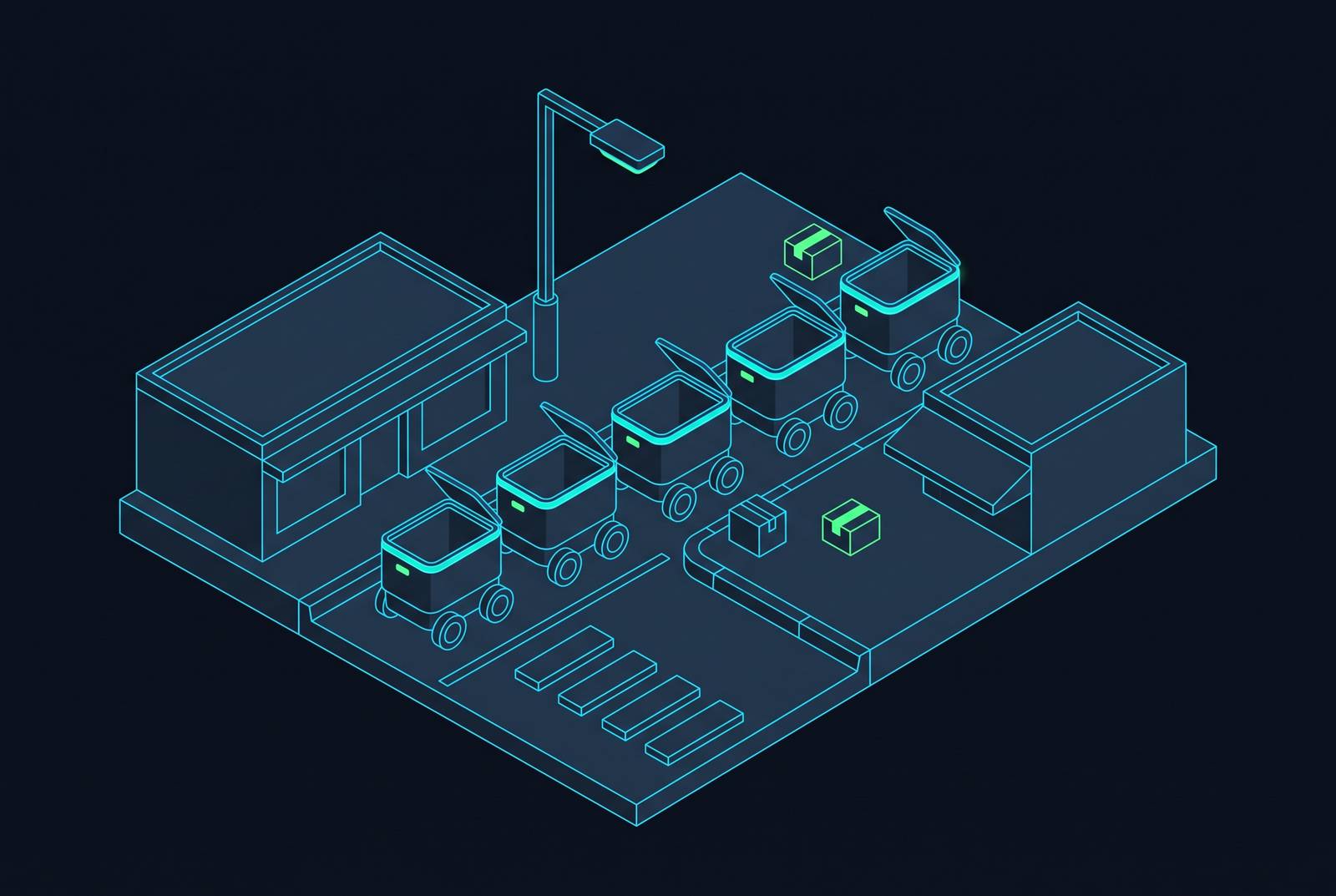
Last-mile delivery costs so much because every stop is different, every window is tight, and every solution still depends on a human being behind a wheel. That final segment, the trip from a depot or a curb to someone's front door, accounts for 53% of total shipping costs despite covering the shortest physical distance in the entire supply chain. The inversion is the whole problem: the cheapest part of the journey to plan on paper turns out to be the most expensive part to run. Urban congestion, missed first-attempt deliveries, and a shrinking pool of drivers willing to do the job all add cost on top of a model that was already strained before fuel prices climbed further. Same-day and two-hour delivery windows, once a premium add-on, are now the baseline customers expect, and that expectation presses on a system with little slack left to give.
Drivers of 2026 Adoption
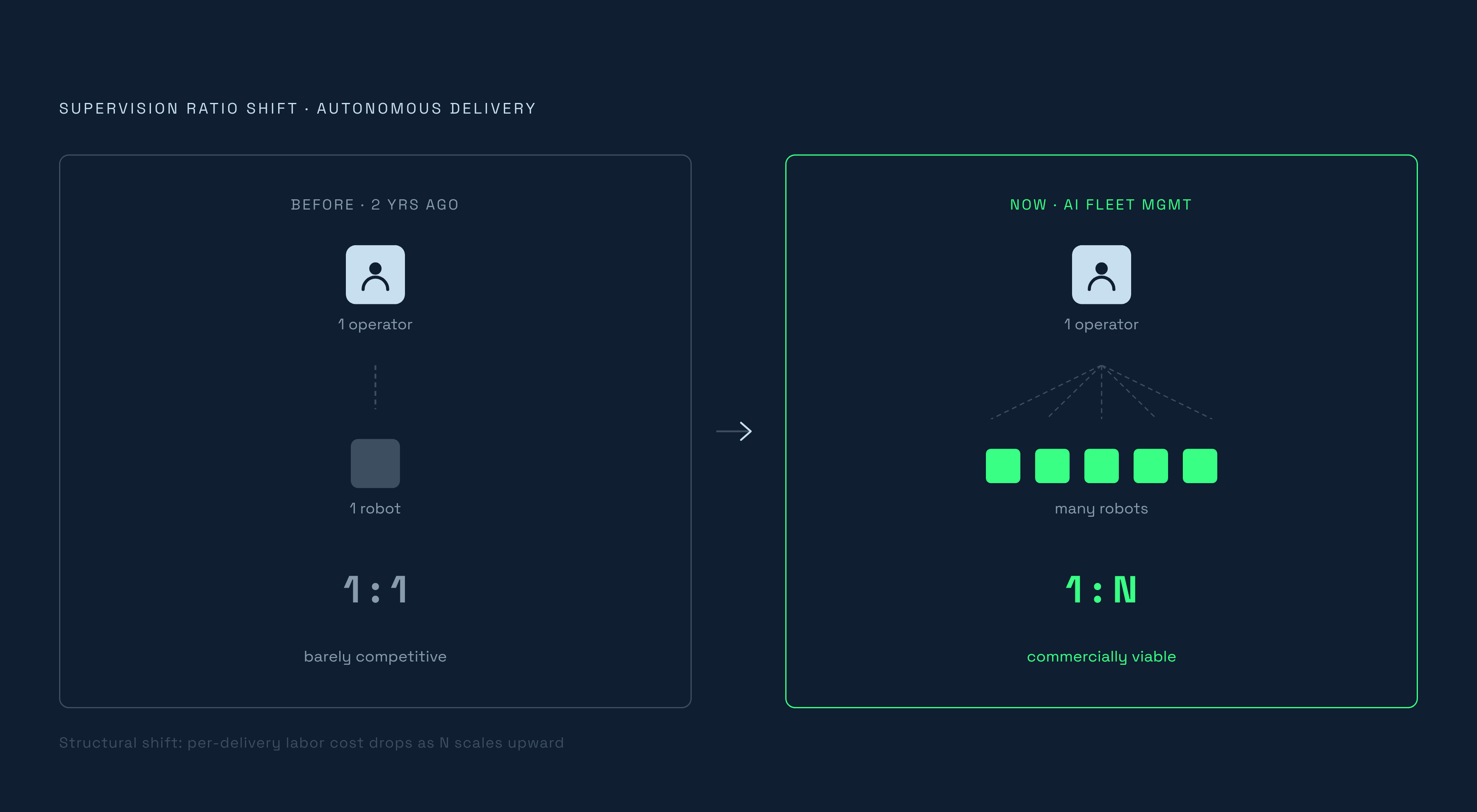
Three changes have converged at once to move autonomous delivery out of the pilot phase and into commercial infrastructure: the cost of the hardware has fallen, regulation has started to catch up, and the economics of running a fleet now work at scale. None of these alone would have been enough. Falling component costs without regulatory clearance would leave robots that work in a lab but can't legally cross a street. Regulatory clearance without a viable cost structure would leave a legal product nobody can afford to run.
What changed the cost structure most is the labor model behind each robot. AI-based navigation paired with cloud fleet management now lets a robot operate with limited human supervision, and the per-delivery labor cost has fallen sharply as a result, compared to the remote-operator setup that was still standard just two years ago. When a single remote operator had to watch one robot closely to keep it safe, the economics barely beat a human courier. When software can handle most of the navigation and a single operator can watch over many units instead, the math changes.
The effect is visible in deployment numbers rather than press releases. The market has moved from controlled pilot programs into commercial-scale deployment, with tens of thousands of units now running in cities worldwide in 2026. That count signals a working business, not an experiment still looking for product-market fit. Robot manufacturers are partnering with the logistics platforms that already own the customer relationship, the restaurant contracts, and the delivery app, so together they build shared infrastructure that lowers the risk of deployment for both sides. A manufacturer doesn't have to build demand from scratch, and a platform doesn't have to build hardware and sensing systems in-house.
How sidewalk robots navigate a dense city block
A sidewalk robot stays upright and on course because of layered sensor fusion, not any single sensor doing the job alone, and the reliability of that layering is what separates a robot that can run commercially from one that only works in a research demo. Each sensor type exists to cover a failure mode the others can't handle. LiDAR maps the geometry of a sidewalk precisely but can be blinded by heavy rain. Cameras read the scene in color and recognize objects, but they lose depth perception in flat or low light. Ultrasonic sensors pick up what cameras miss closest to the ground, which matters at a curb edge where a robot has to judge a drop of a few inches correctly every time.
Dense cities add a problem that suburban test tracks don't: tall buildings block and bounce GPS signals, a phenomenon known as the urban canyon effect, in which a robot's sense of its own position can drift by meters in the time it takes to cross a block. Robots handle this by fusing GPS with visual odometry, essentially tracking how the scene around them shifts frame to frame, so the system doesn't need a clean satellite signal to know where it is.
All of this sensor data gets processed locally, on an onboard computer (typically an NVIDIA Jetson Orin platform) rather than sent to the cloud and back. That local processing handles object detection, path planning, and obstacle avoidance in the time it takes to react to a pedestrian stepping off a curb, and that window is too short to survive a cloud round-trip. The cloud still matters, but for a different job: fleet management software running remotely handles route optimization, learns traffic patterns across the whole fleet, and pushes map updates to every robot overnight. The split is deliberate. The robot decides what to do in the next second on its own; the fleet software decides what the robot should do over the course of a day.
Two physical design choices follow from this same logic. Robots run at 4 to 6 mph, matching a walking pace, and that's a constraint chosen on purpose rather than a technical ceiling. Moving at walking speed keeps collision energy low if something does go wrong, and it keeps the robot's behavior predictable enough for pedestrians to read it the way they'd read another person on the sidewalk. Battery range averages 20 to 30 km per charge, so you get a natural service radius of roughly 3 to 6 miles. That radius is also the distance band where a small robot making one delivery at a time costs less than sending a van.
How delivery robots fit into the broader logistics chain
The model that is making money in 2026 is a dispatch system that assigns each delivery to whichever mode fits it best: drones, sidewalk robots, e-bikes, or EV vans, chosen by software based on weight, distance, urgency, and the kind of location at the other end. A package headed to a suburban house might go out by drone. An apartment delivery a few blocks from a restaurant might go by sidewalk robot. A heavy or oversized item still goes by van. One fleet software platform makes that assignment call across all four modes, so each mode is a tool suited to particular jobs, and the robot isn't a wholesale replacement for the vehicle fleet.
Micro-fulfillment centers inside city limits are what make this coordination possible. Self-driving freight and conventional trucking move goods from larger suburban distribution hubs to these smaller urban nodes, and there, automated sorting loads the right package onto the right vehicle for the final leg. Fleet orchestration platforms, including systems offered by various vendors, operate at this layer: they take in delivery requests and match them to available modes and capacity in something close to real time. That software layer is what turns four separate delivery technologies into one coherent network instead of four companies running parallel, overlapping services.
One problem this network still hasn't fully solved is getting a package past the point where the sidewalk ends and private property begins, sometimes called the last-meter problem: a locked building gate, a secure lobby, a garage with no one home to buzz a courier in. Operators are working around this with partnerships: smart-home systems, secured digital drop-boxes, and automated garage access.
Food delivery is where this multimodal model has taken hold fastest, and it accounts for roughly a third of all deployed robot units in 2026. The reasons are specific to the job: the delivery radius is short, the time window is tight, and a small autonomous unit making one restaurant run beats a van that can't justify a single stop economically.
Who is operating robots at scale now
The operators who have moved past the pilot stage share a pattern. They started small, in constrained environments where failure was cheap to absorb, built up operational data from those deployments, and are now making structural, capital-backed bets on full city deployment rather than waiting for regulators to hand them a clean, unified set of rules.
Starship Technologies shows most clearly that this model can become ordinary infrastructure. In Finland, Starship's robots already complete roughly one in five grocery deliveries, a share high enough that the robots have become a normal part of how groceries move rather than a curiosity. Starship is trying to replicate that normalized model in American cities: in October 2025, the company raised a major Series C round and announced plans to expand its fleet substantially by 2027. A raise and an expansion plan of that size signal a long-term infrastructure commitment.
DoorDash is running two strategies at once, and the contrast between them says a lot about how a major platform manages regulatory risk. Its in-house Dot robot completed its first official delivery on March 5, 2026, in Fremont, California, at the Fremont Restaurant Week kickoff event. Dot operates on roads, bike lanes, and sidewalks at speeds up to 20 mph, considerably faster and more road-capable than the typical sidewalk robot. At the same time, DoorDash runs the Coco robot brand, already active in Los Angeles, Chicago, and Miami, using remote human operators who each supervise multiple units. Coco's per-unit economics are worse than a fully autonomous system, but the tradeoff buys DoorDash lower regulatory friction when it enters a new market. So DoorDash can run both systems in parallel and deploy whichever version regulators will accept in a given city, while it keeps building toward full autonomy everywhere.
Serve Robotics, founded within Postmates and spun out after Uber's 2020 acquisition of that company, is now publicly traded under the ticker SERV. Serve expanded its fleet roughly twentyfold in 2025, and partnerships with major delivery platforms and retail brands drove that growth. The rate of that expansion shows a company scaling a working model rather than adding units slowly while it searches for one.
Kiwibot, smaller than the others, operates in campus and urban food delivery with partnerships that include Grubhub. Its path illustrates a different strategy available to smaller operators: rather than building a parallel delivery network from the ground up, Kiwibot integrates directly into the platforms and demand that already exist.
The regulatory patchwork that shapes where robots can operate
Regulatory fragmentation in the country where these robots operate isn't a temporary phase that will smooth out as the technology matures. It reflects how American cities govern public space, street by street and council by council, and it means a robot that operates legally on one city's sidewalks may be barred outright a few miles away. More than 30 U.S. states now have active legislation covering personal delivery devices, but almost none of those laws line up with each other.
That lack of alignment creates real operational cost. A company entering a new city has to learn a new speed limit, a new cap on fleet size, a new fee structure, and a new set of permit rules nearly every time, even though the robot rolling off the truck hasn't changed. You can see the range clearly in how different cities have responded. Tennessee passed landmark legislation in February 2026 allowing autonomous delivery robots onto bike lanes, road shoulders, and parking lots, with the law taking effect July 1, 2026, a notable expansion beyond the sidewalk-only framework most states still use. San Francisco, which has more real-world sidewalk robot deployment experience than almost any other American city, has responded in the opposite direction: tightening its regulations and keeping deployments limited to pilot zones after pedestrian complaints turned the issue into a political problem city officials could no longer set aside. Toronto has gone further still, prohibiting delivery robots from sidewalks and bike lanes since 2021, a decision made after a recommendation from the Toronto Accessibility Advisory Committee backed by accessibility advocacy groups. It remains the most restrictive policy among major North American cities.
At the state level, the overall direction is toward expansion rather than restriction, and Tennessee's law points to where other states may be headed. But state law only sets the outer boundary. City-level enforcement and permit conditions decide what actually happens on a given street, and that local layer is where most of the day-to-day friction lives.
This fragmentation acts as a filter on who can compete. A company with the legal and operational resources to tailor its compliance approach city by city can keep expanding into new markets even where rules differ sharply. A smaller operator without that capacity gets boxed into the handful of cities where the rules happen to already fit its model. That filtering pressure is part of why integration with large platforms, the pattern seen in Kiwibot's Grubhub partnership and in DoorDash's dual-track approach with Dot and Coco, functions as a regulatory strategy and not just a distribution shortcut.
Where sidewalk robots create genuine problems
The accessibility and safety concerns raised about sidewalk robots are documented, and they give cities like San Francisco and Toronto real grounds for the caution they've shown. These aren't abstract policy worries. In October 2025, an Avride delivery robot operating for Uber Eats collided with a Jersey City resident in an on-street bike lane, causing a concussion and a broken clavicle. According to the NJ Bike & Ped Resource Center, the robot appeared to leave the scene after the collision before a bystander physically stopped it, a detail that leaves open questions about what protocol, if any, governs a robot's behavior immediately after it hits someone. In September 2026, Coco Robotics acknowledged that a sidewalk deployment error caused a robot pileup on a sidewalk near Lincoln Park in Chicago. That incident didn't happen in isolation: Chicago already had a documented record of delivery robot problems before it occurred.
Operators point to Finland as the strongest counter-evidence available. Starship's robots complete roughly one in five grocery deliveries there, and they don't produce anything like the safety and accessibility concerns the American incidents have raised. But the cities where robots succeed differ from the cities where they've struggled in ways that matter directly to this comparison: sidewalk width, pedestrian density, and the legal framework governing public space all diverge enough that a result achieved in one market doesn't automatically transfer to another. The gap between a market where robots have become unremarkable and one where a robot colliding with a pedestrian makes the news is a gap in infrastructure and policy. Closing it is the work still ahead of the industry, not behind it.
Sources
- Last-Mile Delivery Fleet Technology 2026
- Top 10 Last Mile Delivery Robot Brands to Know
- How Autonomous Last-Mile Delivery is Reshaping Urban Retail Logistics in 2026
- Last Mile Delivery Robot Market Growth Forecast to 2035: Autonomous Fleets Scale Amid Urban Logistics Demand - News and Statistics - IndexBox
- Delivery Robots in Cities: Smart Urban Robotics Transforming Last-Mile Delivery Systems
- Last-Mile Delivery Robot Regulations 2026: State-by-State Laws in the US
- Inside the growing role of robotics in smart city logistics