Robot-as-a-Service Pricing Models in Industrial Automation
Subscription models let manufacturers access robots without board-level capital approval.
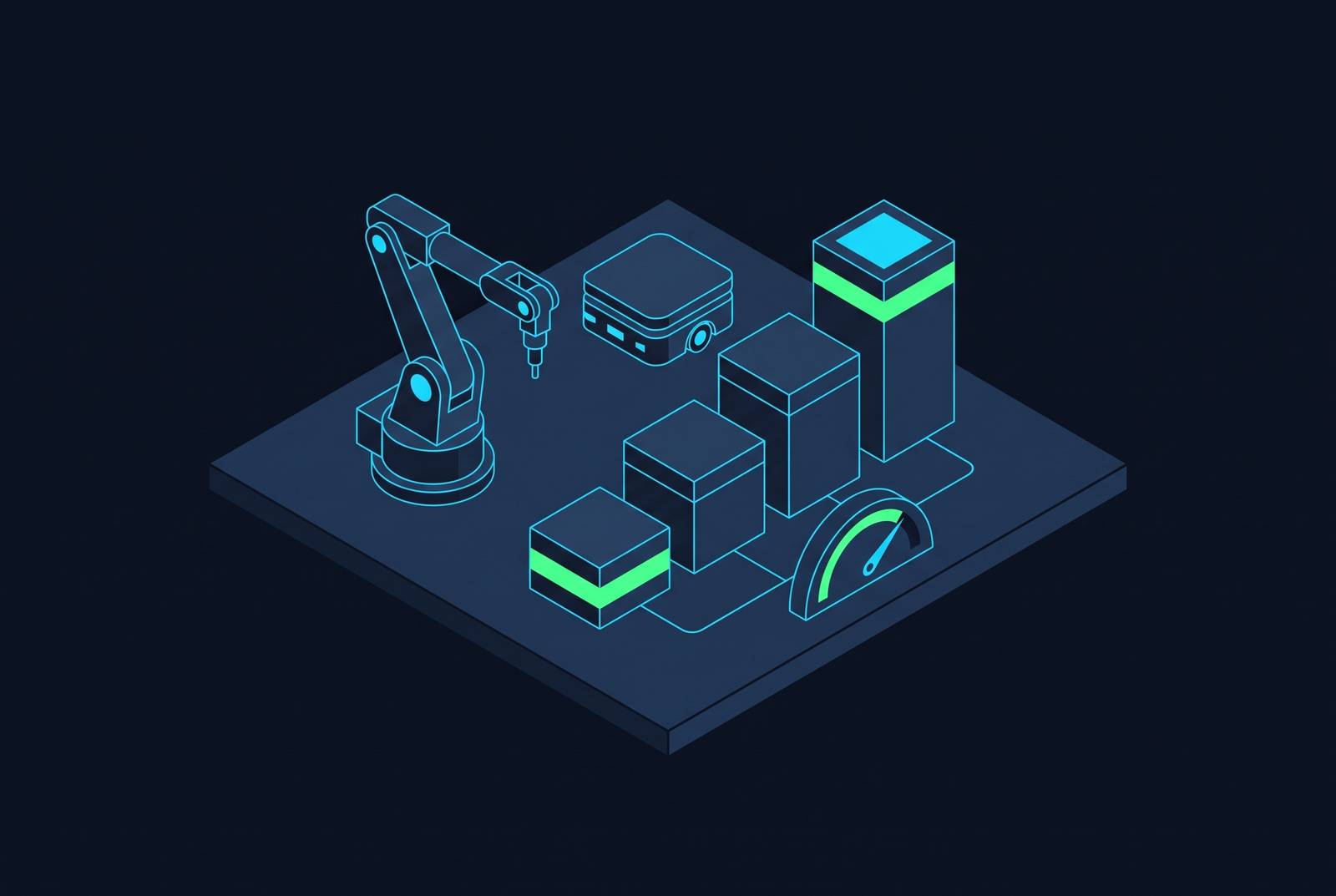
Robot-as-a-Service pricing exists because the traditional path to owning an industrial robot runs through a capital outlay few manufacturers can absorb without a board meeting. Four distinct pricing structures have emerged to solve that problem in different ways: fixed subscription, usage-based, outcome-based, and hybrid models. Which one fits a given buyer depends less on preference than on deployment scale, demand variability, and how much operational risk that buyer is willing to hand to a vendor.
The Capital Cost of Industrial Robots
A standard 6-axis industrial robot arm carries a substantial hardware price on its own, a figure confirmed by the IFR's World Robotics 2025 report and echoed across multiple 2026 pricing guides. That number, though, is the beginning of the bill, not the end of it. End-of-arm tooling, integration labor, safety enclosures, software licensing, and facility modifications push a fully deployed cell well past the hardware price alone, and over a 7-year operating horizon, total cost of ownership tends to run close to double the initial capital outlay or more. Support costs keep compounding after installation: software updates and remote diagnostics typically add another 10 to 15 percent of the purchase price every year, indefinitely.
Cobots and mobile robots have brought the entry hardware price down substantially compared to traditional industrial arms, but that integration multiplier, the tooling, the labor, the safety systems, still applies on top. Lowering the sticker price of the robot itself does not remove the layers of cost stacked around it.
None of this is purely a cost problem. It is an authorization problem. A high-value automation cell requires sign-off at the board level, while an equivalent monthly fee can be approved by a production manager without ever reaching that level of scrutiny, a distinction Future Market Insights has flagged as a central driver of the shift toward subscription models. Robots have not gotten too expensive to justify. They have gotten too expensive to approve quickly, and that gap between justification and approval is what every RaaS pricing model is built to close.
What RaaS does to that cost structure, and why it became viable now
Robot-as-a-Service does not make automation cheaper in some magic accounting sense. It reallocates who carries the technology risk. Under a subscription arrangement, the buyer gets a predictable operating expense and the right to upgrade equipment as it ages, while the provider absorbs the risk that the hardware becomes obsolete and fronts the capital needed to build and deploy the fleet against a revenue stream that only pays back over years.
That reallocation only became workable at scale because of three specific technical developments. AI-driven autonomous navigation let robots operate with less bespoke integration work per site. Cloud connectivity gave providers a live window into how every unit in a fleet is performing. Over-the-air software updates meant a fleet-wide fix or feature no longer required a technician driving to every facility.
Remote monitoring, in particular, is what makes the whole arrangement financially sound from the provider's side. Predictive maintenance built on that monitoring data is what lets a provider promise guaranteed uptime and still keep the cost of servicing each unit low enough to make the subscription math work. Without it, uptime guarantees would just be a bet the provider hopes to win.
Adoption numbers show the scale of the shift. The IFR World Robotics 2025 Service Robots report records global professional service robot sales reaching nearly hundreds of thousands of units in 2024, with the RaaS fleet growing substantially as companies sought flexible integration without high upfront costs. Three forces are pushing that trend at once: the sheer absolute cost of owning robots outright, a need for automation capacity that can flex with demand rather than sitting fixed, and labor shortages across manufacturing and logistics that are not easing on their own.
Fixed Monthly Subscription
The fixed monthly subscription is the model most buyers encounter first, and for good reason: it gives both sides of the deal the predictability they need to plan around. A single monthly fee covers the robot, its software, maintenance, and support, typically under a contract running 12 to 36 months, with the fee scaled to fleet size. The predictability cuts both ways, though. Whether the arrangement actually delivers on its CapEx-to-OpEx promise depends entirely on what gets bundled into that one number.
A subscription that is genuinely zero-CapEx should fold in the hardware itself, round-the-clock monitoring, every scheduled and unscheduled maintenance visit, ongoing software upgrades, and an uptime guarantee backed by a real service-level agreement. Buyers should read closely for any of those pieces carved out as separate line items, since that is where a "zero-CapEx" pitch quietly stops being zero-CapEx.
One advantage of the subscription structure has no real equivalent in an outright purchase: technology-refresh rights. As a provider's fleet evolves, subscribers get hardware and software upgrades folded into the existing fee rather than facing a new capital decision every time the technology moves forward. Existing RaaS subscribers can access new offerings through their current contract rather than requiring a new procurement cycle. A capability upgrade like that becomes part of what a subscriber is already paying for.
The model's momentum shows in who is now offering it. ABB Robotics introduced a RaaS platform for small and mid-sized manufacturers with minimal upfront costs in September 2025, and FANUC Corporation launched a subscription-based rental model in October 2025.
The risk sits in fleet sizing. A buyer who signs up for more capacity than needed pays every month for idle robots, while a buyer who under-sizes the fleet loses the flexibility that made the subscription attractive over a straight purchase.
Usage-Based Pricing
Usage-based pricing solves a different problem than the fixed subscription does. Instead of committing to a fleet size and paying for it whether or not it is fully used, the buyer pays only for hours of actual robot operation. Industry pricing data puts entry rates as low as $8 per hour of operation.
That comparison is exactly the point. At those rates, usage-based RaaS competes head-on with loaded labor cost per hour across many U.S. manufacturing markets, and the return on investment becomes something a plant manager can calculate in real time rather than something amortized quietly over a multi-year contract. Under a capital-purchase model, high-utilization operations tend to reach payback only after well over a year of continuous operation; usage-based pricing collapses that timeline into a per-hour decision made fresh every shift.
The bundle underneath a usage-based contract usually mirrors what a fixed subscription includes: hardware, round-the-clock remote monitoring, full maintenance coverage, and an uptime guarantee. The hourly rate is the only thing that actually varies.
Formic Technologies, based in Chicago, is the defining practitioner of this model at scale. Formic deploys automation cells for palletizing, case packing, machine tending, and autonomous mobile robots into mid-market U.S. manufacturers on pay-per-month, zero-CapEx terms with guaranteed uptime, and in September 2025 it launched Formic Production Intelligence, a cloud platform giving customers real-time visibility into performance data across their production lines.
Usage-based pricing fits operations with real volume swings: seasonal ramps, demand-driven overtime, pilot deployments where nobody yet knows what steady-state usage will look like. It fits those situations far better than it fits a stable, high-throughput line running consistent multi-shift volume, where a fixed subscription will almost always come out cheaper per hour once utilization stabilizes. A buyer running three shifts a day, every day, should model both structures before assuming the flexible option is the cheaper one.
Outcome-based pricing: when the value metric shifts from time to operational output
Outcome-based pricing asks a different question. Instead of billing for hardware access or hours of use, it bills for a defined operational result: pallets moved, bins picked, cases processed, square feet cleaned, energy saved. The buyer is no longer paying for a robot. The buyer is paying for a number to move.
That number has to meet a high bar to work as a billing metric. It has to be unambiguous, clearly attributable to the robot rather than to the surrounding process, and measurable in real time. The same cloud connectivity, monitoring, and AI vision systems that enable subscription pricing are a precondition here too.
For the buyer, this is the cleanest transfer of risk available in the market. If the robot underperforms, the bill shrinks, and obsolescence, maintenance, and performance risk all sit with the vendor rather than the customer. For the vendor, offering that deal requires operational visibility tight enough, and predictive maintenance mature enough, to guarantee uptime with confidence. A provider that cannot make that guarantee has no way to price by output and stay solvent.
Outcome-based billing is not yet the industry's dominant commercial form. It appears mostly in pilots and in verticals where the task is standardized enough to define a clean metric. Output can swing for reasons that have nothing to do with the robot, such as a change in product SKU mix, a supply disruption upstream, or a facility layout redesign, and untangling the robot's contribution from those outside factors makes contract-writing genuinely difficult. Outcome-based pricing represents where the incentive alignment between buyer and vendor is headed. It is not yet where most contracts sit today.
Hybrid and lease-to-own structures: how buyers blend models to match their actual risk profile
Few real deployments fit neatly into one of the three models above, and vendors who can blend terms tend to close deals that a single rigid structure would lose.
Lease-to-own combines the low upfront access of a subscription with a defined path to eventual ownership at the end of the contract. It suits buyers who want to prove out the ROI case before committing capital, and it suits applications where the long-run economics clearly favor owning the equipment once the buyer is confident the deployment works.
A more common hybrid pairs a fixed subscription covering a base fleet with usage-based overage pricing for demand above that baseline, separating predictable cost from variable cost in a way that mirrors how cloud computing contracts have long been structured. A related pattern applies outcome-based pricing only to performance above a guaranteed floor, with a fixed subscription covering the baseline itself, limiting the vendor's exposure while still rewarding performance beyond the threshold.
Fleet portability has become its own axis of value, distinct from price. Locus Robotics has described a customer that shifted production to Mexico and then moved it back to the United States as tariff policy changed, carrying its subscription terms across both moves. A capital purchase ties a buyer to a facility in a way a portable subscription does not, and that difference matters more as trade policy keeps shifting under manufacturers' feet.
The broader direction across providers is toward a full-stack offering: hardware bundled with fleet management software, monitoring, maintenance, spare parts, and uptime guarantees all under one contract. The line between a subscription and a fully managed service keeps getting harder to draw, and hybrid pricing is a direct reflection of that blur.
Matching Deployment Scale and Operational Variability to a Model
No one RaaS model wins across every situation. The right structure comes down to three variables: how large the deployment is, how variable the demand is, and how much operational complexity the buyer is prepared to carry. Mismatching those variables against the wrong pricing model causes RaaS deployments to quietly underdeliver, because the contract structure never fit the operation it was sold into.
Scale is the clearest of the three. At small fleet sizes and short trial periods with steady daily utilization, RaaS models beat capital purchase on total cost fairly consistently. Once scale and utilization both grow large and stable, capital purchase regains the advantage, and if a buyer stays in RaaS at that point, a fixed subscription is the structure most likely to still compete on price.
Demand variability points toward usage-based or hybrid structures whenever volume swings seasonally or with demand. That flexibility depends on infrastructure buyers rarely ask about directly: how a provider handles robots that come back from a site that no longer needs them. A buyer evaluating a usage-based or hybrid contract should ask how the vendor refurbishes and redeploys returned units before signing, since that capacity is what makes the flexible pricing possible in the first place rather than just promised on paper.
Risk tolerance sorts the remaining choice. Outcome-based pricing transfers the most risk to the vendor and fits situations where the task is standardized enough to define a clean metric and where the buyer genuinely cannot absorb performance uncertainty. Subscription models transfer technology-refresh and maintenance risk specifically. Outright purchase leaves every bit of risk with the buyer.
The math behind all of this depends on local labor costs and regional pricing, not a single universal calculation. A warehouse in a high-labor-cost metro market reaches payback on a given deployment faster than an identical warehouse in a low-labor-cost region, because subscription fees tend to stay geographically flat while the labor savings they're compared against do not. A pricing model that clears the bar in Chicago will not automatically clear it in a market where wages run lower.
Buyers weighing all of this against RaaS should also price out the lean capital-purchase alternative before assuming subscription is the default answer. Standard Bots offers its RO1 cobot at a competitive list price with built-in vision and no separate software licensing fee, and that kind of affordable, off-the-shelf hardware purchase narrows the gap between owning outright and subscribing. It is a useful benchmark to run the numbers against.
None of the four models solves for organizational readiness, and that is the point easiest to lose in a pricing comparison. RaaS lowers the barrier to starting an automation project. It does nothing to lower the barrier to running one well once the robots arrive on the floor. A production team that signs a subscription before it has the staffing and process discipline to actually absorb a new deployment has not solved its automation problem; it has just changed which invoice arrives every month. RoboBusiness 2026 has scheduled a session, "The RaaS Playbook: Pricing, Service & Scale," featuring Locus Robotics CEO Rick Faulk among other panelists, built specifically to address the practitioner questions, financing terms, service coverage, uptime guarantees, customer success, that a pricing sheet alone never answers.