Construction Site Robots for Inspection and Monitoring
Robots equipped with cameras and sensors enter hazardous spaces to catch construction defects early.
Construction Site Robots for Inspection and Monitoring.
Construction inspection's continued reliance on human presence
Construction employs more people worldwide than almost any other industry, and it remains one of the least productive. Manufacturing has tripled its output per worker since 1960; construction has stayed flat, or slipped backward, over that same stretch. More than three-quarters of U.S. construction projects run late, and Virginia Tech and Procon Consulting point to that delay rate as a main reason to bring robots into inspection work.
Part of the trouble is that progress monitoring on a live site is close to a black box. Without real-time visibility into what's happening on the floors, in the ceilings, and behind the walls, defects and sequencing errors go unnoticed until they've already turned into rework, and rework is where budgets go to die.
The human cost is not abstract, either. U.S. construction sees over 1,000 fatalities and 170,000 non-fatal injuries every year. Confined spaces, upper floors without permanent guardrails yet, and excavations held up by partial shoring are the places inspectors have to go to do the job. Falls, collapses, and struck-by incidents happen in exactly those places. Robots do not replace the judgment an experienced inspector brings to a bridge soffit or a cracked weld. What they do is go first, into the crawl space or under the deck, and bring back the data a person needs to make the call from somewhere safer.
The three main robot types used for construction inspection
These are not competing designs chasing the same job. Each one earns its place by matching a specific site condition or a specific sensor requirement, and treating them as interchangeable is where a lot of buying decisions go wrong. Anyone shopping for "a construction robot" as a single category has already misunderstood the problem.
The dividing line runs mostly along terrain and payload. Drones move fast and cover wide, open areas well, which makes them the obvious pick for rooftops, facades, and general site surveys, but they cannot get inside an enclosed ground-level space. Quadrupeds and humanoids exist precisely to cover the ground a drone cannot reach, and the three categories differ mainly in the terrain they handle and the sensors they carry.
Inspection and survey drones account for 41% of all construction robot deployments, the highest adoption share of any category. No single platform wins across every use case. Site access, terrain, and what the data has to feed into next, a progress report, a BIM model, a safety audit, decide which robot actually gets sent out, and that logic runs through every deployment discussed below. The applications seeing the most use on active sites today are aerial drones, quadruped robots such as Boston Dynamics' Spot, and humanoid robots carrying cameras, LiDAR, and other sensors.
Aerial drones: capabilities and leading platforms
Construction drones capture high-resolution aerial imagery, 2D orthomosaic maps, 3D models, digital elevation models, and LiDAR scans, data types that feed directly into progress tracking and quality workflows. The real value sits in what happens to that data after the flight.
DroneDeploy has positioned itself as the platform doing the most with that data, running across more than 3 million sites worldwide. Late in 2025 it rolled out three AI agents built on vision-language models: Safety AI, Progress AI, and Inspection AI. Safety AI alone has flagged over 90,000 safety risks across customer projects, and Progress AI claims 95% accuracy on progress tracking, with results back in minutes instead of days. DroneDeploy has also started running docked drones, permanently stationed units that launch and land themselves with no pilot standing by, already active on more than 100 projects, and it has autonomous ground robots in beta for 2026, which would take the platform off the roof and onto the ground floor.
Skydio and DJI sit alongside DroneDeploy as standard kit on large construction sites, each with its own approach to flight autonomy and sensor fusion, though the available figures do not break out deployment counts for either the way they do for DroneDeploy. The smart construction drone market was valued at $3.77 billion in 2025, projected to hit $4.3 billion in 2026, a 14.1% jump in a single year https://birdseyeaerialdrones.com/construction-companies-adopting-drone-inspections-2026/. That growth rate says something the marketing copy doesn't: aerial inspection has stopped being a novelty line item and become a budgeted, recurring cost on large jobs.
What drones still cannot do matters just as much. A drone does not enter a mechanical room, does not climb into a crawl space, and cannot inspect a soffit from three feet away with a hand on the surface. Anyone who buys a drone fleet expecting it to replace ground inspection entirely will find that out the hard way, usually after the crawl space under a mechanical floor goes unchecked for a full quarter. That gap is exactly where ground robots take over.
Quadruped robots: terrain capability, sensor payloads, and the platforms available today
Legged robots earn their spot on a construction site by going where wheels and rotors cannot. Uneven terrain, autonomous operation without someone piloting it by hand, and the ability to carry several sensor types at once let a quadruped do what a drone simply cannot: enter a confined space, get close enough for a detailed structural read, or work an unfinished interior floor by floor. Legged robots crossed $1.8 billion in value in 2025 and are projected to reach $8.4 billion by 2030, pulled up by demand from energy, mining, construction, and defense https://seraphim.vn/pages/robotics/quadruped-robots-spot-go2.
Boston Dynamics' Spot leads on scale, with over 1,500 units working across oil platforms, power plants, construction sites, and research labs worldwide. Hensel Phelps runs Spot with a laser scanner attached for autonomous QA and progress tracking, and Caltrans has put the platform to work inspecting culverts and bridge soffits across roughly 1,200 active construction projects worth close to $14 billion combined. Spot also serves as one of the ground units inside Virginia Tech's MARIO project, covered further down.
Boston Dynamics and FieldAI announced a partnership in March 2026 aimed at pushing robotics further into construction and other environments that shift constantly and unpredictably. FieldAI reports site inspection and documentation time down more than 90% against manual methods, plus a real drop in how often workers have to enter hazardous areas themselves. The company has raised around $405 million to date, and McLaren Construction in the UK is already running FieldAI's quadrupeds for 360-degree site imagery, safety compliance checks, and quality assurance.
ANYbotics' ANYmal takes a different bet, built around mechanical toughness and an IP67 ingress rating that holds up in dust, moisture, and rough terrain. That toughness made it the default under European oil-and-gas inspection mandates, so moving into construction is a natural next step from that industrial base rather than a new direction.
Unitree, with its Go2, B2, and G1 lines, competes almost entirely on price, using vertically integrated manufacturing to undercut Spot by a wide margin. In April 2026, UK contractor Tilbury Douglas deployed the Unitree G1 humanoid to capture 360-degree imagery and progress reports feeding into health and safety monitoring.
Ghost Robotics' Vision 60 comes out of a defense background, backed by a major South Korean defense acquisition and deployed across multiple U.S. military installations. Its construction case study reports a 40% cut in manual inspection time, better incident detection through combined thermal and visual monitoring, stronger compliance through automated reporting, and steady performance in dusty, muddy, debris-choked conditions https://www.ghostrobotics.io/case-studies/autonomous-ground-robots-for-construction-site-inspection.
Chinese manufacturers led by Unitree dominate global unit shipments through vertically integrated supply chains and dramatically lower bill-of-materials costs, while Western platforms from Boston Dynamics and ANYbotics command premium pricing through certification depth, enterprise integration, and global support infrastructure. Spot's base price runs $74,500, with fully configured units often clearing $150,000. Buying on unit price alone misses what the premium actually pays for: the cheaper platforms win on sticker cost, and the pricier ones win on what happens when a joint actuator fails at 2 a.m. on a job site three time zones from the vendor's support desk. Spot Cam 2, released January 2026, adds a 4K PTZ camera with 25× optical zoom, radiometric thermal imaging, a 360 × 130° spherical camera, and eight ultra-bright LED lights for illumination in dark environments.
How quadruped robots connect to BIM and digital twins during active construction
The sensor payload was never the endpoint. Quadruped robots are built to feed 3D reality capture, safety data, logistics information, and inspection results straight into BIM and digital-twin systems, and that integration is a core design goal rather than something bolted on afterward.
A peer-reviewed study in Automation in Construction, led by Tuomisto and colleagues at Aalto University, shows how far that integration has come. The team ran a Boston Dynamics Spot fitted with an Ouster OS0 LiDAR unit for localization and mapping and an Intel RealSense D415 camera for image capture, navigating the site using a BIM model as its map. Testing covered three scenarios: a simulated dynamic environment run 20 times, simulated BIM discrepancy detection also run 20 times, and real-world validation. The BIM model pulled double duty, serving as both the navigation reference and the benchmark against which the robot compared what it actually found on site. The robot worked out on its own which BIM objects needed inspecting, moved to them, and flagged where reality diverged from the model, with nobody walking it through the route.
That changes what "as-built versus as-designed" comparison means in practice. Instead of one review at project milestones, the comparison runs continuously, and a discrepancy that would once have appeared at final inspection is caught within days. Steve DeVito at Procon Consulting states the logic: digital models stay useful only if they are built on the most current, measured version of reality. Removing the continuous robotic capture stops a digital twin from being a living reference. It becomes a frozen design file that drifts further from the actual building with every week that passes.
Multi-agent systems: coordinating drones and ground robots for continuous site coverage
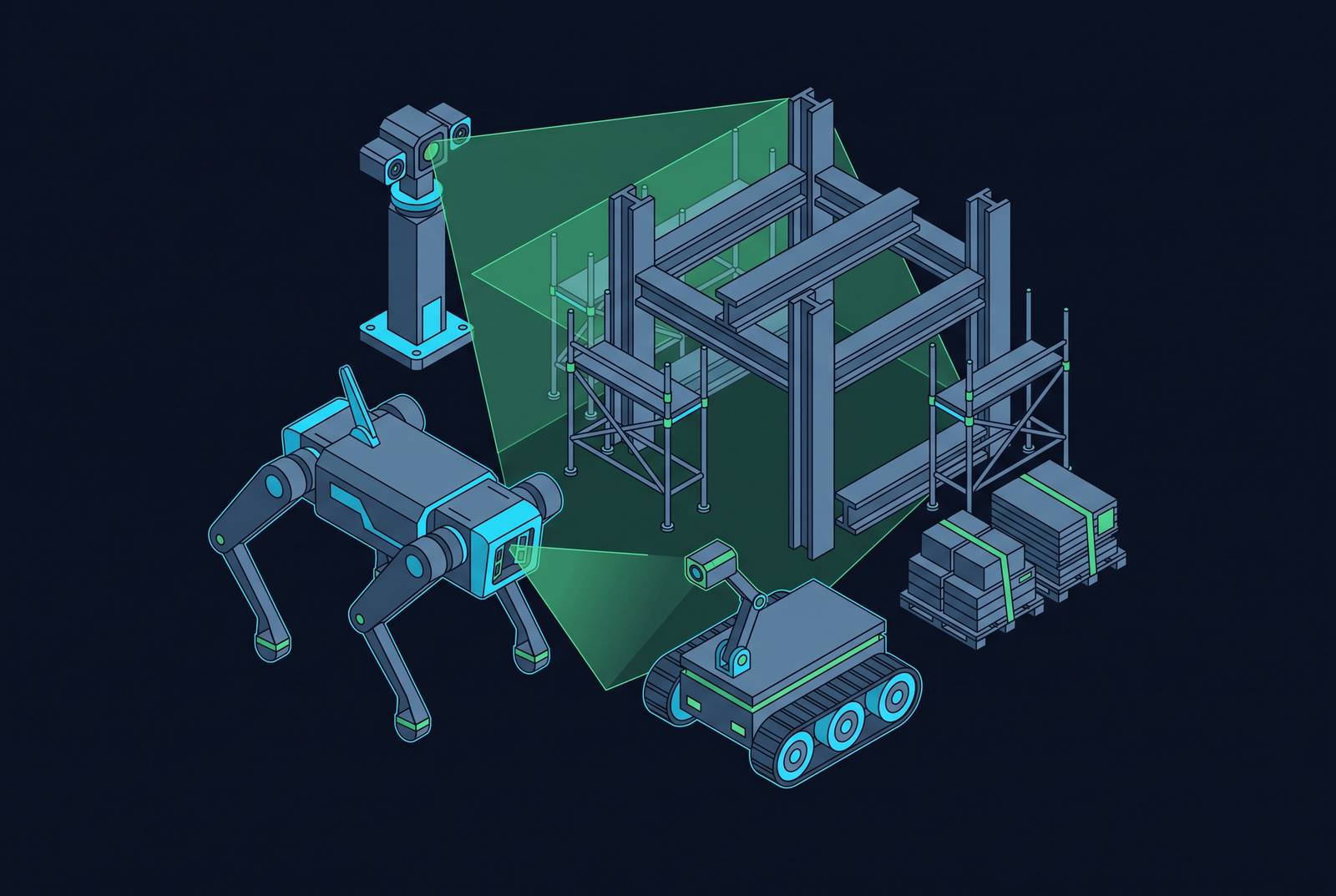
Virginia Tech and Procon Consulting's MARIO project, short for Multi-Agent Robotic System for Inspection On Site, points at where this technology is headed next. It coordinates humanoid robots, quadrupeds, and aerial drones into one continuous, remote monitoring system. The team behind it sums up the ambition in a useful shorthand: something like Google's Satellite and Street View capture, but for buildings and infrastructure.
The logic holds up once laid out. Aerial units sweep the open site and the rooftops. Ground units handle the confined spaces and interiors. Run together, they close the blind spots that neither one covers alone. A single inspector, watching from one location, can supervise several robots working across several sites at once, which scales expert judgment without needing to scale headcount to match it. The structured data coming back, visual and sensor readings from both air and ground, surfaces coordination problems, installation defects, and sequencing errors early enough to actually fix them.
There is a less obvious benefit here. Afsari and DeVito, the Virginia Tech and Procon researchers, point out that by removing the need for physical presence on site, multi-agent remote inspection workflows can open construction inspection roles to people with disabilities, caregivers, or those located far from major project sites. That answers the labor shortage differently than simply hiring more inspectors. It widens who can do the job.
None of this ships yet. MARIO remains a research and development effort, not a product on the market, and this level of coordinated, multi-agent work is at the frontier of the field, well ahead of what a typical contractor can buy and deploy this year.
What robots get deployed on active sites today and the evidence for what they deliver
Look at what is already running, not what is promised. An industry report from Zacua, published through buildwcg.com, concludes that construction robotics has moved past the pilot-project stage into repeatable, production-grade deployment, backed by $1.36 billion in venture funding and named robots doing named jobs on major sites https://www.buildwcg.com/blog-posts/construction-robotics-2026-adoption-production-zacua-report.
Progress tracking is where the economics land hardest. Hensel Phelps runs Boston Dynamics' Spot with a laser scanner attached for autonomous QA and progress tracking, a live, named deployment rather than a pilot.
Confined-space inspection tells a similar story out of the public sector. Caltrans runs Spot to inspect culverts and bridge soffits across roughly 1,200 active projects worth close to $14 billion combined. Meeting confined-space safety rules the traditional way, atmospheric monitoring, ventilation setup, sometimes a full traffic shutdown, adds real time and cost to what should be a routine check. A robot that gets in without triggering all of that overhead changes when an inspection happens and keeps it on schedule.
Safety compliance monitoring rounds out the picture. McLaren Construction in the UK runs FieldAI quadrupeds for 360-degree site imagery alongside safety and quality checks, and Tilbury Douglas, also in the UK, runs its Unitree G1 doing much the same kind of work. Different platforms, different price points, same underlying bet: a robot walking the site every day catches what a human inspector, stretched across too many projects, is bound to miss.
The industry has a real labor gap to fill here too. The Association of Builders and Contractors puts the shortfall at more than 454,000 additional construction workers needed to meet demand in 2025 https://www.arch.tamu.edu/news/2025/07/12/embracing-construction-robotics-the-future-of-construction-field-operations/. Robots do not close that gap on their own, but the deployments already running, DroneDeploy across 3 million sites, Safety AI's 90,000 flagged risks, Spot's 1,500-plus units in the field, are the closest thing the industry has right now to evidence that the technology earns its keep rather than decorating a pitch deck https://dancumberlandlabs.com/blog/ai-site-inspection-construction/ https://www.easy-robots.com/en/articles/boston-dynamics-spot-review. That is not a marginal return. This gap makes the rest of the debate, drone versus quadruped, Boston Dynamics versus Unitree, look secondary to the plainer fact that the capture itself pays for itself many times over. A monthly structured robotic capture program costs $3,500–$5,500, with conservative claim-avoidance value estimated at $80,000–$150,000, yielding a payback measured in weeks, not years. Construction has over 1,000 fatalities per year in the US alone https://www.roboticscenter.ai/applications/construction-robots. Inspection and survey drones account for 41% of all construction robot deployments https://www.roboticscenter.ai/applications/construction-robots. DroneDeploy is operating docked drones on over 100 projects https://dancumberlandlabs.com/blog/ai-site-inspection-construction/. DroneDeploy's Progress AI cites 95% accuracy for progress tracking https://birdseyeaerialdrones.com/construction-companies-adopting-drone-inspections-2026/. The base price of Boston Dynamics Spot is $74,500 https://www.easy-robots.com/en/articles/boston-dynamics-spot-review. A fully configured Boston Dynamics Spot robot often exceeds $150,000 https://www.easy-robots.com/en/articles/boston-dynamics-spot-review. FieldAI reduced site inspection and documentation time by more than 90% compared to manual processes through partnership with Boston Dynamics https://research.contrary.com/company/fieldai. FieldAI has raised approximately $405 million in total funding as of June 2026 https://research.contrary.com/company/fieldai.

Sources
- Embracing Construction Robotics: The Future of Construction Field Operations - Texas A&M University College of Architecture
- Robots and AI are tackling some of the biggest challenges in construction
- Automating on-site object inspection with a quadruped robot and BIM - ScienceDirect
- AI Site Inspection in Construction: 3 Tools for 2026
- Construction Robots: Market, Technology & Deployment Guide 2026
- ghostrobotics.io
- easy-robots.com
- birdseyeaerialdrones.com