Autonomous Mobile Robots in Warehouse Fulfillment
Autonomous Mobile Robots in Warehouse Fulfillment.
Why warehouse fulfillment is under structural pressure right now
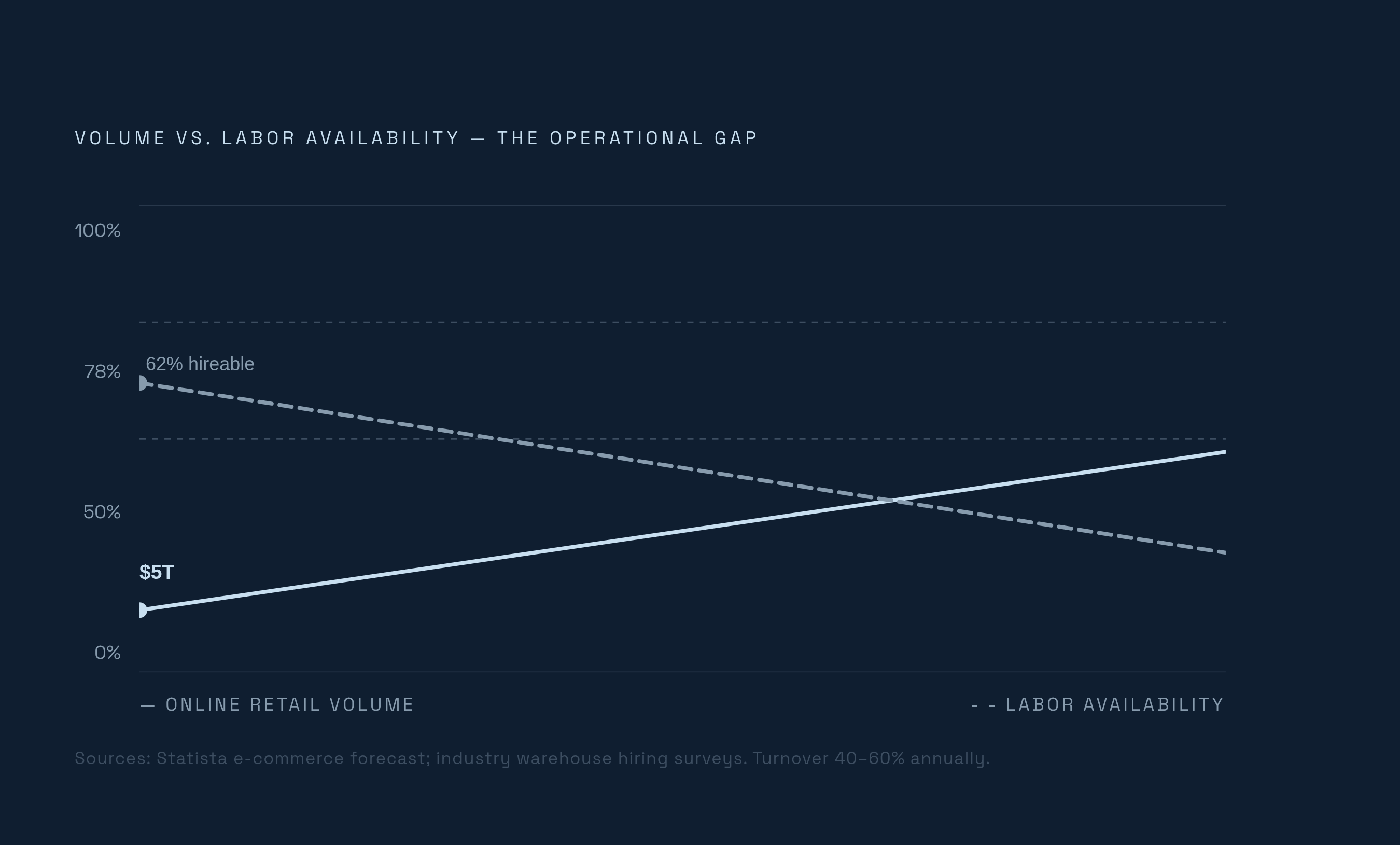
Warehouse fulfillment has hit a wall, and the wall is made of people who aren't there. Roughly 78% of facilities report significant difficulty hiring and retaining warehouse staff, and nearly 500,000 U.S. warehouse jobs sit open according to Instawork's 2025 State of the Warehouse Industry. That's a persistent vacancy problem masking itself as something milder. It's a persistent vacancy problem that shows no sign of closing on its own.
Even the workers who do get hired don't stay long. Annual turnover in warehouse roles commonly runs above 40 to 60% Neo Intralogistics. A large share of any given facility's workforce is perpetually mid-training rather than fully productive Neo Intralogistics. Germany alone expects to lose 7 million working-age people by 2035, showing that the labor shortage isn't a temporary post-pandemic blip but a structural feature of the next decade across developed economies, driven by an aging workforce Neo Intralogistics Advice Scout.
Meanwhile, volume keeps climbing. Global online retail surpassed $6.5 trillion in 2025 and is projected to reach $6.88 trillion in 2026, up from roughly $5 trillion in 2021 Robotics Center Sellers Commerce. Fulfillment centers absorbing that growth cannot simply post more job listings and expect the gap to close, because the applicant pool that used to fill those listings has shrunk Robotics Center Sellers Commerce. A survey by Modern Material Handling found that 66% of warehouse managers expect labor shortages to become a major operational challenge within the next two years. It's one they're already living inside, and it's expected to get worse before it gets better. The convergence point: labor scarcity plus volume growth plus same-day delivery expectations creates an operational gap that cannot be closed with headcount alone, and this is the specific pressure AMRs are designed to address.
What distinguishes an AMR from earlier automation
Automated guided vehicles, the AGVs that have moved pallets around factories for decades, follow fixed paths laid down in the floor itself: magnetic tape, embedded rails, or beacon networks that tell the vehicle exactly where to go and nowhere else. Autonomous mobile robots do something categorically different. They build a live map of their surroundings and reroute around people, forklifts, and shifting floor layouts in real time, without anyone tearing up the concrete first.
That distinction sounds technical, but its consequences are entirely practical. An AGV deployment locks in a floor plan; move a rack, and someone has to re-lay the guidance infrastructure. An AMR deployment can absorb a seasonal reslotting, a new SKU mix, or a full facility reconfiguration without touching the floor at all. That flexibility is why the market has already made its choice: AMRs now outsell AGVs roughly 3 to 1 in new deployments, as operators increasingly value adaptability over the certainty of a fixed rail Robotics Center. Warehouse and logistics applications account for 32.94% of total AMR deployments across every sector that uses them, from manufacturing to healthcare, which makes fulfillment the dominant use case by a wide margin Warehouse Revolution.
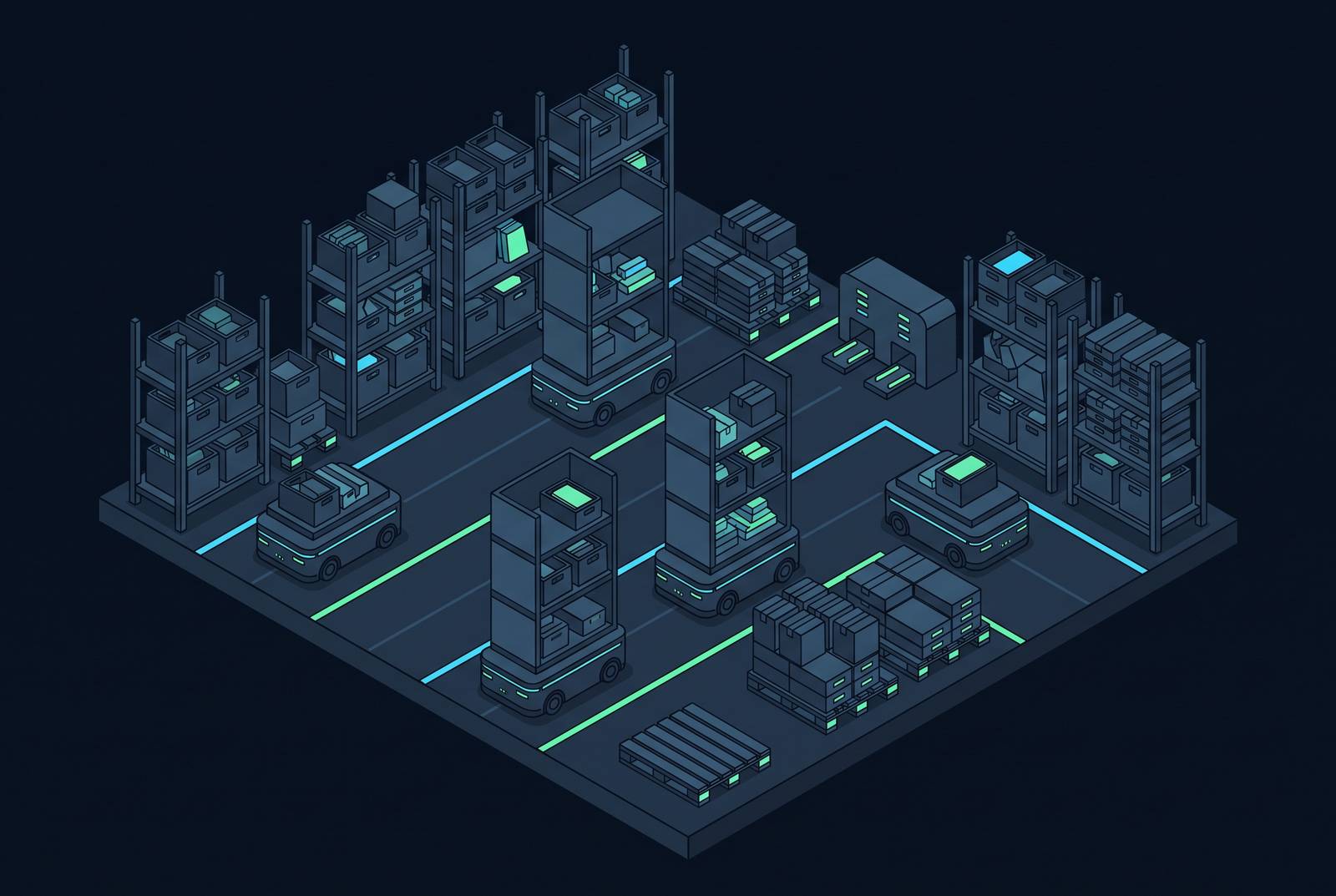
Inside a fulfillment center, "AMR" isn't one machine but a family of them, each built for a different task. Goods-to-person robots haul entire shelving units to a stationary worker. Autonomous forklifts and pallet movers handle heavier, bulkier loads between dock and storage. Inventory scanning robots patrol aisles logging stock levels. Sortation robots sort parcels by destination before they hit an outbound dock. These machines move inventory and position it in front of a person, but the actual pick, the moment where a specific item gets lifted, verified, and confirmed into an order, remains a human task in most current deployments. That division of labor matters enormously for understanding what these systems actually replace, and what they don't.
How AMRs navigate: the technology stack under the hood
Navigation is where AMR vendors actually differentiate themselves, more than in the chassis or the battery. Laser and LiDAR systems build a real-time map by measuring reflected light off surrounding surfaces, giving high precision in structured environments like racking aisles. Vision-based guidance uses cameras and computer vision models to interpret the environment directly, and it's become more common as camera hardware has gotten cheaper. SLAM usually rides on top of LiDAR or vision hardware rather than replacing it.
Visual SLAM specifically was flagged in Research and Markets' report as an area of active development for warehouse AMRs, suggesting the industry still sees meaningful headroom in how robots interpret camera data alongside spatial mapping. In practice, most complex brownfield facilities, the ones retrofitting automation into an existing building rather than designing one from scratch, end up running hybrid navigation that blends several of these modalities, because no single one handles every corner of a real warehouse. Lower-cost options like magnetic sensors, RFID tags, and inertial sensors still show up too, though they come with more constrained operating envelopes.
What ties all of this together is artificial intelligence, and it's no longer a premium add-on. By late 2024, 67% of new AMRs shipped with dynamic path planning and real-time obstacle avoidance built in, making the capability a baseline expectation rather than a differentiator Sellers Commerce. Dynamic path planning means the robot keeps re-evaluating its route as it moves, based on live congestion, rather than picking a path once at the start of a task and sticking to it regardless of what's in the way. That distinction matters most in high-density operations where aisle traffic never really stops.
Payload capacity is the other axis that segments this market technically. Units under 100 kg handle totes and light shelving. The 100 to 500 kg tier moves cartons and mid-weight pallets. Anything above 500 kg handles full pallet loads, typically in heavy manufacturing or bulk logistics settings, and each tier demands a different sensor package and drive-train design to match. The progression from a mid-tier tug to a heavy-duty mover, paired with dedicated fleet software, tracks the broader industry's move toward covering the full payload spectrum rather than a single niche. In June 2025, ABB unveiled the Flexley Mover AMR P603 at Automatica 2025, a heavy-duty AMR designed for high-capacity material movement; in March 2024 ABB had already introduced the Flexley Tug T702 alongside its AMR Studio software suite for centralized fleet management (Sellers Commerce).
Fleet orchestration: why the robot alone is not the product
The single clearest lesson to come out of the 2025 wave of deployments, according to Logistics Viewpoints' January 2026 review of what worked and what didn't, is that AMRs are not plug-and-play hardware. They demand disciplined operational design and continuous tuning after installation.
The failure mode is most visible in mixed-fleet environments. Facilities running AMRs alongside AGVs, conveyors, shuttles, and human pickers found that their warehouse management systems and individually siloed robot controllers simply couldn't coordinate the combined system. Congestion built up at intersections, task assignments were missed, and robots sat idle while work piled up elsewhere in the building. An orchestration platform is supposed to prevent exactly that: it continuously evaluates open work orders against the state of every resource in the building, a robot's charge level, a human picker's location, a conveyor's current throughput, and reassigns tasks dynamically instead of locking in a static schedule.
Logistics Viewpoints' conclusion for 2026 is blunt: the competitive differentiator is no longer the robot itself but the software layer coordinating the fleet, and vendors competing purely on hardware specs are losing ground to those with strong orchestration software. That software layer has become a market of its own, valued at USD 210 million in 2025 and projected to reach USD 750 million by 2034. Among Tier-2 logistics operators globally, hybrid fleet operations, meaning multiple robot types and human workers under one coordination layer, grew substantially, and more than half of these hybrid systems relied on fleet management software to handle interoperability and zone-based navigation.
The next shift is already visible. Next Move Strategy Consulting's analysis found that agentic AI is starting to let the WMS layer handle operational exceptions on its own, making real-time decisions without escalating to a human supervisor. That's a meaningful change in where judgment is required on the floor. NMSC's field assessments across more than 50 warehouse deployments found that vendors with strong integration into existing WMS and WES systems consistently outperform hardware-first competitors, which reinforces the same point from a different angle: the robot has to talk to the rest of the building, not just move through it.
What AMRs deliver: performance figures from live operations
Start with the walking. In a traditional warehouse, a picker covers six to twelve miles per shift just moving between storage locations, and that distance is pure overhead, time spent traveling rather than picking Advice Scout. Framed by task rather than by outcome, AMR-based goods-to-person systems reduce picking labor requirements by roughly 70%, since the robot handles aisle traversal and item retrieval while the human stays put at the workstation for the pick-and-confirm step Neo Intralogistics.
Storage gets denser too. Modern Material Handling reports that 62% of logistics and warehousing facilities using robotics report productivity gains exceeding 27%. On the financial side, case studies point to 42% five-year OPEX reduction with payback periods around eight months, and broader deployment data shows payback under 24 months with ROI above 250% in live operations.
Numbers like these are useful, but a single case tells the story more concretely than any aggregate figure can. In the first year, the company handled nearly three times its previous order volume without adding a single additional associate. Its clients' actual volumes swung 30 to 40% above projections, and Saddle Creek still hit its service-level agreements. Fulfillment Director Cody Jones summed it up simply: "The robots give us the ability to scale."
That phrase is the whole thesis in miniature. The return on investment here isn't primarily about trimming headcount. It's about absorbing volume spikes without a proportional increase in labor cost, and Saddle Creek's numbers show that more clearly than any industry-wide average could. Geek+'s shelf-to-person design yields a 35–50% increase in overall storage density versus traditional static selective racking, while sustaining picker rates of 300–400 picks per hour (Advice Scout). The Saddle Creek Logistics case study (sourced from Saddle Creek's own case study page). Productivity more than doubled after AMR deployment.
How human-robot collaboration works on the floor
The operating model in nearly every current deployment is augmentation. Robots handle transport, humans handle judgment, and in goods-to-person systems specifically, neither one fully substitutes for the other. Where displacement does happen, it tends to concentrate in the narrowest, most repetitive tasks, walking aisles, manually carting totes, and even there, history suggests those roles tend to shift into different work rather than vanish.
Safety improves as a side effect of this arrangement. AMRs come equipped with obstacle detection and emergency stop systems, and facilities report fewer workplace injuries as robots take over the repetitive, high-traffic movement that used to put people in the path of forklifts and carts. Amazon's own workforce data offers the clearest large-scale illustration of what this transition looks like in practice. The company upskilled more than 700,000 employees through robotics and technology-focused training programs since 2019, the largest documented example of workforce transition running alongside AMR scale-up.
The fuller picture is more nuanced than either a pure-growth or pure-displacement story would suggest. Amazon's fulfillment workforce grew from around 175,000 to more than 1.6 million globally between 2018 and 2023, even as its robotics fleet scaled past 750,000 units. The net effect across the company was growth. Amazon's own disclosures show that within specific low-skill picking and packing roles, targeted headcount reductions of 10 to 15% did occur alongside throughput gains of 25 to 50% in the most automated centers. Both things are true at once, and neither cancels the other out.
None of this happens without redesigning the floor itself. Workstations shift from something a picker walks toward to something a picker stands at, since robots now bring the shelf to the person rather than the reverse. Ergonomics change too, less walking, more repetitive upper-body motion at a fixed station, and shift structures have to account for the fact that robot uptime doesn't follow a human clock. The task boundary between person and machine keeps moving as well. Amazon's Vulcan robot, first shown at a Dortmund event in May 2025 and featured again at a London robotics event in June 2026, was described as the company's first robot with a genuine sense of touch, capable of handling fragile and irregularly shaped items that previously needed a human hand. That's a meaningful signal about where the line between human and robot work is headed next.
Amazon as the clearest signal of where production-scale AMR deployment leads
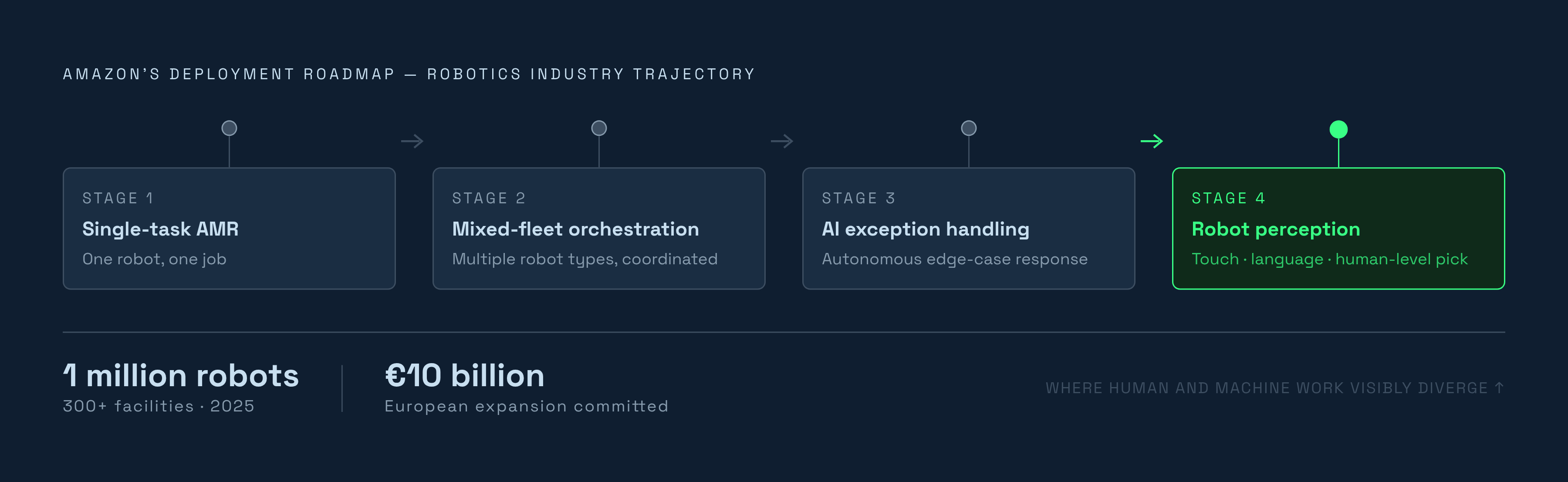
Two milestones mark the transition from pilot to production more clearly than anything else in the sector. Amazon announced deployment of its one millionth robot across more than 300 facilities worldwide in 2025, and DHL Supply Chain crossed 500 million robot-enabled picks using AMRs. Neither of those numbers describes a proof of concept. They describe infrastructure operating at national and continental scale.
Amazon's June 2026 robotics event in London laid out where that infrastructure is heading next. It introduced Vulcan, described as its first robot with a genuine sense of touch, for handling fragile and irregularly shaped items. It announced that the STARK robotic tote-handling system, already piloted in Barcelona, would expand to 15 European sites by 2027. And it committed more than €10 billion in European investment behind all of it.
That path is also widening the gap between operators who've started down it and those who haven't. Interact Analysis projects that only around 26% of warehouse sites globally will have some form of automation by 2027, while Gartner predicts half of all new warehouses built in developed markets will be designed as robot-centric facilities by 2030. Warehouse automation order intake still grew 7% year-on-year in 2025, even against a weak macroeconomic backdrop, driven by large-scale facility investment from major retailers. Investment isn't slowing down, even when the broader economy gives operators every excuse to pause. Amazon unveiled its next-generation Proteus robot, capable of receiving natural-language instructions and autonomously planning its own routes (a significant leap beyond rule-based navigation). Amazon's trajectory reveals for other operators that the path runs from single-task AMR deployment → mixed-fleet orchestration → AI-driven exception handling → robots with perception sophisticated enough to take on tasks previously reserved for humans.
The current vendor landscape
The vendor market has settled into three rough categories: hardware-first specialists, software-first orchestration platforms, and integrated providers trying to offer both Robotics Center. Which type suits a given operator depends heavily on the starting point, a greenfield facility built around robots from day one looks nothing like a brownfield warehouse retrofitting automation into decades-old racking, and a single-workflow deployment has very different needs from an end-to-end system.
Geek+ has held the top global AMR market share for seven consecutive years, with 48.5% share specifically in goods-to-person solutions according to Interact Analysis. Its portfolio spans shelf-to-person systems, tote handling, pallet movement, sorting, and factory logistics, making it one of the few vendors equipped to handle both a narrow single workflow and a large end-to-end project under one roof. GreyOrange occupies a different position, identified by MarketsandMarkets as a notable smaller player with a strong foothold in specialized niche areas, and it appears alongside Geek+ and Locus Robotics in Research and Markets' warehouse AMR report.
Locus Robotics, profiled in that same report, launched Locus Array in 2026, a fully autonomous fulfillment system that combines mobile robotics, AI-powered perception, and an integrated robotic picking arm working directly within warehouse aisles. It's built to manage picking, putaway, replenishment, induction, and slotting without manual intervention, which pushes further into the territory that used to require a human at every step. MarketsandMarkets names ABB a star player, alongside OMRON Corporation, which sits in the same competitive tier for full AMR deployments.
Mobile Industrial Robots, the Denmark-based manufacturer known as MiR, appears in the same Research and Markets profiling as part of the broader competitive set. And Rockwell Automation entered the space through acquisition, taking on Clearpath Robotics and its industrial division OTTO Motors in October. Taken together, these players show a market where no single company owns the full stack. Success depends on getting the navigation technology, the fleet orchestration software, and the human workflow design to work as one system, not on any single component in isolation. ABB, identified by MarketsandMarkets as a star player, introduced the Flexley Tug T702 AMR and AMR Studio software suite in April 2024 and unveiled the Flexley Mover AMR P603 (heavy-duty, high-capacity) at Automatica in July 2025, signaling that established industrial automation OEMs are aggressively building out intelligent logistics portfolios.
Sources
- Autonomous Mobile Robots Market Size, Share, Latest Trends & Growth Analysis, 2025-2032
- Autonomous Mobile Robot Warehouse Logistics Market Outlook 2026-2030 Featuring Profiles of Geek+, GreyOrange, and Locus Robotics - Market to Reach $24.67 Billion by 2030 as E-Commerce and AI Adoption Accelerate
- Warehouse Automation Statistics (2026)
- Autonomous Mobile Robots (AMR): Complete 2026 Guide for Warehouses
- Autonomous Mobile Robots Market Size Report, 2026-2033
- The Future of Warehouse Automation: What 2025 Taught Us - Logistics Viewpoints
- Warehouse Robotics 2026: AMRs, Picking Robots & Automation Guide | SVRC
- Warehouse Robotics Trends and Industry Impact 2026