Humanoid Robot Pilots in Manufacturing Environments
Manufacturing plants now have real production data to measure humanoid robots against vendor claims.
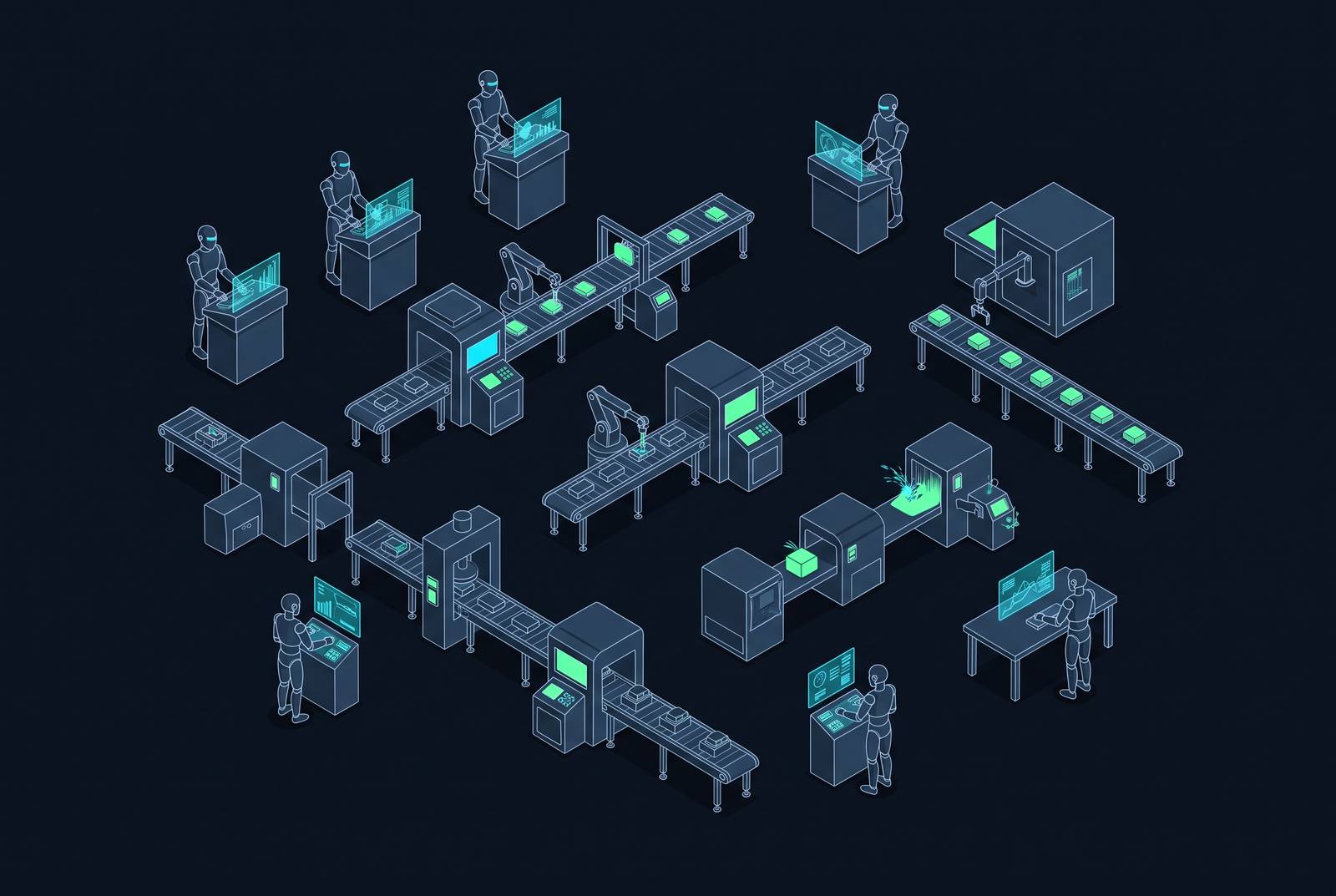
For most of the past decade, a humanoid robot on a factory floor meant a demo reel: a few minutes of footage, a controlled stage, a task run once for the camera. That changed in 2026, when humanoid robots began logging timestamped production hours at named facilities, hours that appear in shift logs rather than press releases. The shift matters because it changes what operators and buyers need to know before they sign a contract: not whether a robot can perform a task in a demo, but how many hours it has run, at what facility, under what supervision.
Three forces converged to produce this threshold. Manufacturing economies face a demographic shortfall projected to leave millions of positions unfilled by 2030, and that gap has made the business case for factory-floor automation more urgent. At the same time, the hardware side of the industry crossed a production threshold, with tens of thousands of humanoid units shipped in 2025, a volume large enough to put real fleets into real buildings rather than single units into trade-show booths.
Deployment tracking from iFactory frames 2026 as the first year procurement teams can plan against hard production numbers instead of vendor projections. That distinction separates this year from every year that came before it. A vendor projection is a claim about what a robot might do; a logged production hour is a record of what it did. The rest of this piece works from that record, starting with the deployments specific enough to name, measure, and compare.
What verified deployments show (the documented cases)
A short list of deployments now carries enough verified operational data to support analysis, and each one is worth describing in full: what the robot is, where it works, what it does, and what the record shows.
Figure AI's Figure 02 and Figure 03 units operate at BMW's Spartanburg, South Carolina plant, where they have logged more than 1,250 operational hours across ten-hour weekday shifts. That work has contributed to the production of tens of thousands of BMW X3 vehicles, with the robots loading sheet metal components by the tens of thousands over the course of the deployment. BMW has since extended the program to Plant Leipzig in Germany, a pilot described as the first humanoid deployment of its kind in Europe, and the automaker has created a Center of Competence for Physical AI in Production to support further work of this kind.
Tesla's Optimus Gen 3 units are deployed at Fremont and at Gigafactory Texas, where they work across battery assembly, EV pack loading, cable routing, and connector seating. Tesla operates as both the manufacturer of the robot and the end customer running it, a structure that removes the customer-qualification step other platforms face before they reach a production floor and makes direct comparison with third-party deployments difficult.
Agility Robotics' Digit units run at Amazon fulfillment centers and at Toyota's Woodstock, Ontario plant. Digit is in paid commercial operation at GXO sites under a Robots-as-a-Service contract, and Agility signed a separate commercial Robots-as-a-Service agreement in February 2026 to place Digit units at the Toyota facility, following a year-long pilot there. The Toyota engagement stands out as one of the longer-running documented humanoid programs, moving in sequence from pilot to commercial contract, a progression other buyers are likely to use as a reference point for structuring their own evaluations.
Apptronik's Apollo units move assembly kits across Mercedes-Benz production lines in Berlin-Marienfelde and in Kecskemét, Hungary, with the program built around deep integration into existing line workflows rather than a standalone cell. Apptronik also partnered with Jabil on a separate pilot covering inspection, sorting, kitting, line-side delivery, fixture placement, and sub-assembly.
Hexagon's AEON platform is piloted at Fill Maschinenbau's Austrian factory for machine tending and inspection, with Hexagon's existing metrology stack providing a closed perception-feedback loop. The arrangement is notable less for the robot than for the integration: a humanoid working alongside an established industrial measurement system rather than replacing it.
Unitree's G1 and H1 platforms are deployed on production lines at BYD and Geely for material handling and inspection. Unitree reports shipping the highest volume of humanoid units of any producer globally in 2025, though the analyst firm Omdia ranks AgiBot first, a ranking Unitree disputes.
Set side by side, these cases describe the same kind of work repeated across different factories and different robots: material handling, parts transfer, tote movement, bin picking, kitting, and light assembly. None of them describes a humanoid welding a car body or stamping a panel.
The narrow band of tasks every verified deployment targets
That pattern reflects a deliberate choice made jointly by vendors and operators, each selecting the tasks where a humanoid can succeed today: wide tolerances, repeatable paths, and lower precision requirements than a line's most demanding stations.
Figure AI has described its focus explicitly as targeting "dull, dirty, and dangerous" material handling, a positioning choice rather than a limitation it is working around quietly. That focus lands on tasks where positional error tolerance is wide and the gap between simulated training and real-world performance is narrower than it would be on a precision station, a pattern borne out by the roughly 90,000 sheet metal components loaded by Figure AI humanoids at BMW Spartanburg, a job defined by repetition and tolerance rather than fine precision.
Traditional fixed-arm industrial robots still hold the precision end of the floor. They achieve repeatability of 0.02 to 0.05 millimeters, run at cycle times several times faster than any current humanoid platform, and carry decades of mean-time-to-failure data behind them. Humanoids are not contesting that ground in 2026, and high-speed, high-precision welding, stamping, and complex sub-assembly, the tasks that define most automotive and electronics lines, stay outside what current humanoid platforms can take on.
This division of labor is a rational deployment strategy rather than a shortfall. Matching a humanoid's strengths to a workstation that fits those strengths, instead of forcing a general-purpose robot into a job built for a specialized machine, is how operators build the kind of reliable production data this article relies on.
Melonee Wise has raised a pointed challenge to the category's broader promise, arguing that "I don't think anyone has found an application for humanoids that would require several thousand robots per facility". For a wide range of tasks, purpose-built equipment, conveyor systems, robotic arms, AGVs, remains more reliable and more cost-effective than a general-purpose humanoid. The manufacturers testing this are betting on reassignment, not on a humanoid out-producing a conveyor system or a six-axis arm at its own job: the same humanoid can be reassigned to a different cell without mechanical reconfiguration, a form of flexibility purpose-built equipment cannot offer, and that flexibility, not raw throughput, is what production buyers are evaluating in these pilots.
The five engineering constraints that define today's ceiling
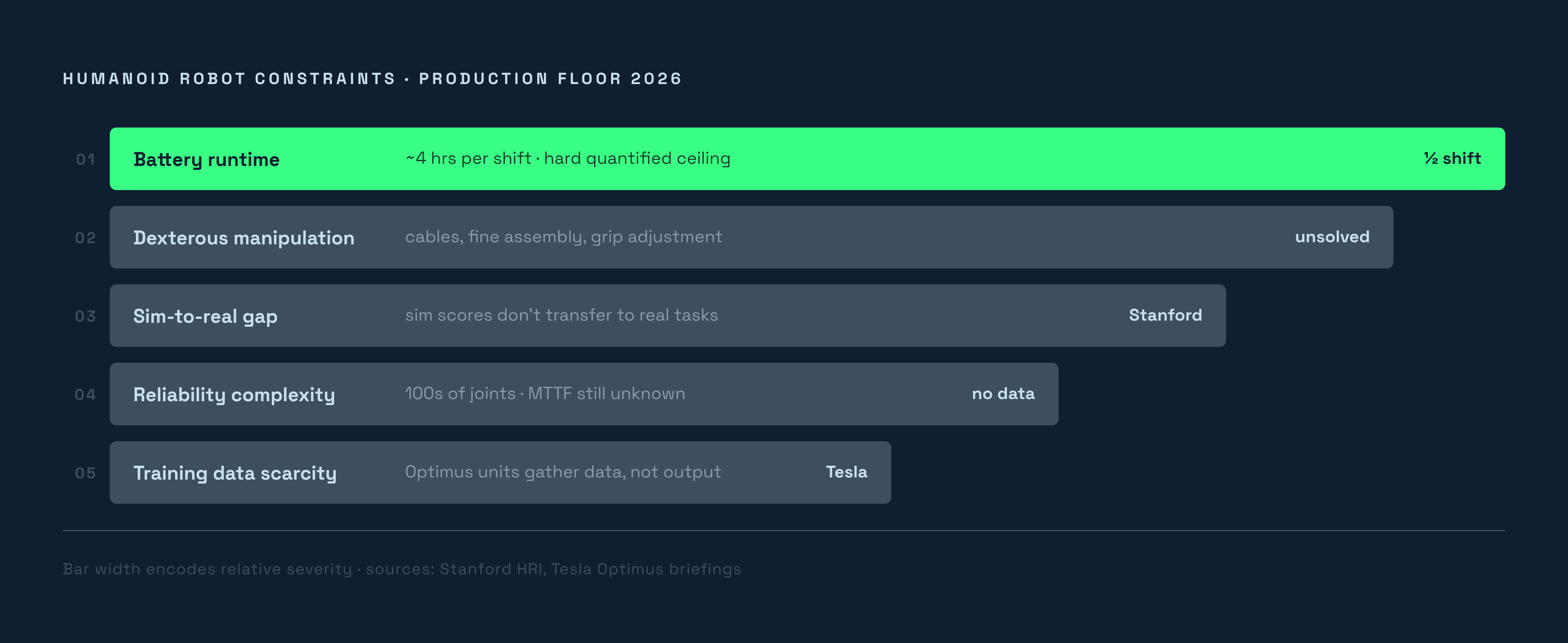
Five structural constraints, not incidental bugs awaiting a firmware update, set the boundary of what a humanoid can be trusted to do on a production floor in 2026.
Battery runtime is the first and most immediate. No commercially available humanoid can finish a full eight-hour manufacturing shift on a single charge; current battery capacity covers roughly half of a standard shift before the robot needs to recharge. Hexagon's AEON platform addresses the problem with a mobile wheelbase and a self-swapping battery system built for continuous shift coverage, but that design is a workaround for the limitation, not a resolution of the underlying battery chemistry and capacity problem.
Dexterous manipulation is the second constraint, and it is the one closest to the task profile described above. Actions a person performs without thinking, picking up a cable, opening packaging, using a hand tool, adjusting grip on a soft or reflective object, remain a genuine bottleneck for current humanoid hands and control systems. That bottleneck explains why deployments favor tote movement and parts transfer over connector seating or fine assembly, even in cases where a vendor describes the work loosely as "assembly."
The sim-to-real gap is the third. Stanford University research, reported in Forbes, found that robots which score well on controlled simulation benchmarks succeed at a much smaller share of equivalent real-world household tasks. That gap widens further on a factory floor, where lighting, flooring, and object position vary continuously in ways a simulated environment does not fully capture. Sim-to-real training pipelines shorten the distance between specifying a task and deploying a working policy for it, but they manage the gap for low-variance tasks rather than closing it.
Reliability complexity is the fourth constraint. A humanoid robot carries hundreds of joints, actuators, sensors, and moving parts, each one a potential point of failure, compared with a traditional industrial arm's six joints. Mean-time-to-failure data for humanoid platforms is still accumulating, and production buyers cannot yet schedule maintenance cycles with the confidence that decades of industrial-arm data already provide.
Training data scarcity is the fifth. Useful robot behavior depends on large volumes of demonstrations, teleoperation logs, sensor streams, and recorded failure cases, and gathering that data in the physical world takes time, hardware, trained operators, and repeated iteration. Tesla has acknowledged that a portion of its Optimus fleet is generating training data rather than production output, an honest acknowledgment that deployment and data collection are intertwined at this stage.
The Integration Timeline from Pilot Approval to Live Production
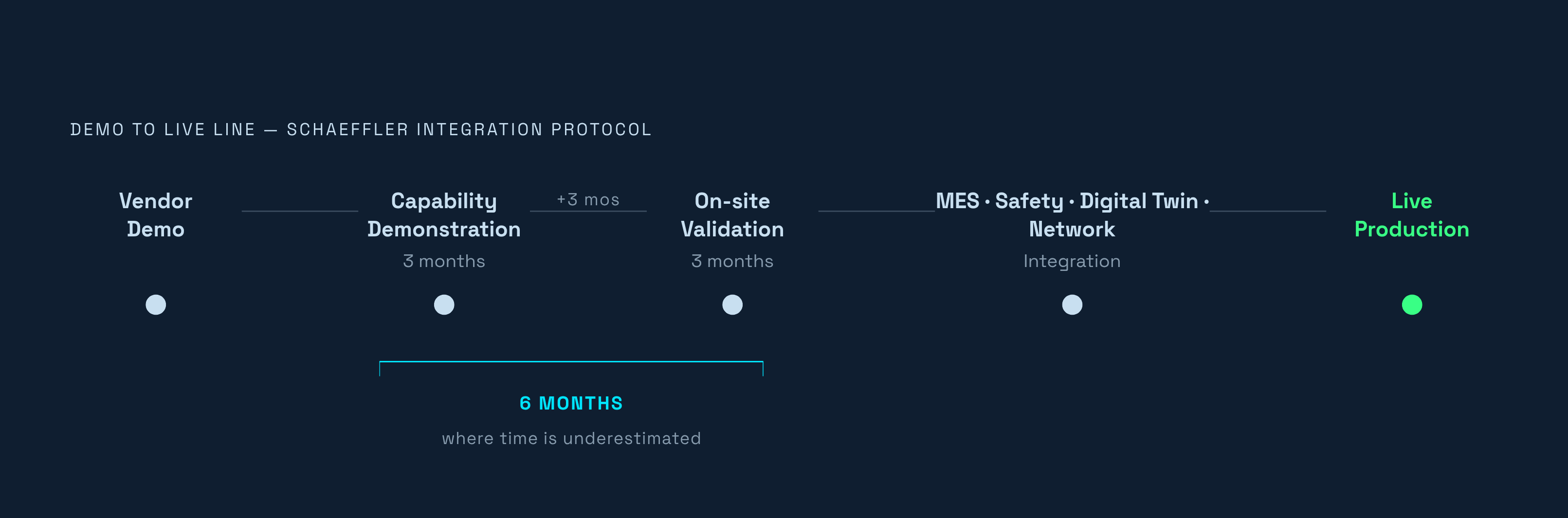
A vendor demonstration shows a robot completing a task. It does not show the three to six months of MES integration, safety system configuration, digital twin development, and network hardening that have to happen before that same task runs on a live line. That gap between the demo and the production floor is where most buyers underestimate the work ahead of them, because a demo by its nature has nothing to show on that front.
Schaeffler has disclosed its own protocol publicly: three months of capability demonstration followed by three months of on-site validation before a robot goes live in production.
Safety infrastructure sits ahead of deployment rather than trailing behind it. Agility Robotics became the first adopter of NVIDIA's Halos for Robotics full-stack safety system, integrating NVIDIA IGX Thor and Halos Core into Digit units deployed at Amazon, GXO, Schaeffler, and Toyota Motor Manufacturing Canada.
Production buyers in 2026 are running parallel evaluation tracks: humanoid pilots for long-horizon flexibility, and certified industrial robot arms for near-term ROI, treating these not as competing choices but as complementary programs with different timelines.
China's state-backed data infrastructure adds a structural asymmetry to this picture. Sixty-four data-collection centers are already operating, with 20 more under construction, deploying humanoids specifically to gather real-world training data at a national scale. Western operators have no equivalent shared infrastructure and have to solve the same data-collection problem individually, facility by facility.
Where the economics work, and where it stays thin
The financial case for a humanoid pilot holds up clearly in the same narrow band of tasks the rest of this piece has described: high-volume, low-precision, physically repetitive work running across long shifts at a single facility. BMW's Spartanburg deployment and Toyota's Woodstock contract both describe sustained operation measured in logged hours rather than one-off demonstrations, and that is the evidence a finance team can actually underwrite. A Robots-as-a-Service contract, the structure Agility used at Toyota, shifts the purchase from a capital expense into an operating cost tied to hours delivered, which lowers the bar for a plant manager to approve a pilot in the first place.
The business case gets thinner as soon as the task moves toward precision work or away from high-volume repetition. A traditional industrial arm, with its 0.02 to 0.05 millimeter repeatability and faster cycle times, remains the better investment for welding, stamping, and fine assembly, and no deployment described here argues otherwise. Melonee Wise's observation about facility-scale deployment cuts directly against any model that assumes a humanoid will eventually replace thousands of purpose-built machines on a single line. The realistic case for a humanoid today rests not on raw throughput against a conveyor system or a six-axis arm, but on flexibility: one robot reassignable across cells without a mechanical rebuild, weighed against the integration cost of getting it there.
That integration cost is real and specific. Three to six months of MES integration, safety configuration, and validation sits between a successful demo and a live line, and Schaeffler's six-month protocol is the clearest public marker of what that work actually costs in time. A buyer evaluating a pilot in 2026 is not just pricing the robot or the per-hour service fee. The buyer is pricing a safety stack that meets regulatory requirements and a training data problem that, outside of China's state-funded infrastructure, has to be solved facility by facility. The pilots described throughout this piece prove that humanoid robots can do real, measured work on a production floor. What they also prove, in the same breath, is how much engineering stands between a pilot that works and a deployment that scales.
Sources
- 38 Best Humanoid Robots in 2026 (Evidence-Ranked)
- Humanoid Robots in Industrial Manufacturing: What They Can (and Can't) Do in 2026
- Humanoid Robots on Manufacturing Floors in 2026
- +++ BMW Group bringing Physical AI to Europe +++ Pilot project at BMW Group Plant Leipzig +++ New “Center of Competence for Physical AI in Production” accelerates global integration of AI and robotics in production +++ First pilot deployment of humanoid robots successfully completed at BMW Group Plant Spartanburg, USA +++