Open-Source VLA Checkpoints for Fine-Tuning
A guide to selecting and adapting open robot vision-language models for your task.
Open-source vision-language-action checkpoints make it possible to adapt generalist robot policies without reproducing proprietary training pipelines. Choosing a starting point, however, requires more than comparing benchmark scores. This survey explains how licensing, embodiment, pretraining data, hardware and adaptation methods determine which checkpoint fits a task, and why the fine-tuning recipe deserves as much scrutiny as the model itself.
Why open-source VLA checkpoints matter now
Vision-language-action models put robot control actions directly into vision-language model backbones, using the visual and language representations learned at internet-scale. Yet most releases have been closed, which has limited access, and how to adapt them to new robots and tasks is still poorly understood. Open checkpoints change the terms of that work. They enable reproducible ablations, controlled comparisons and community fine-tuning rather than access only through proprietary training pipelines.
VLAFlow seeks to separate the effects of architecture, data and training objective. Without comparable checkpoints, improvements remain difficult to attribute to any one of those choices. Practitioners choosing among the open starting points now available need to know what each release actually provides.
What "open" actually means across the confirmed checkpoint landscape
Downloadable parameters permit adaptation technically, but the applicable license determines permitted deployment. MIT allows commercial use on permissive terms, and Apache 2.0 also comes with a patent grant. Model-specific terms introduce another category, including NVIDIA's Open Model License and the Llama Community License that OpenVLA inherits through its Llama-2 backbone.
OpenVLA's code is MIT-licensed, but its weights are still governed by the backbone terms. GR00T N1.7 allows commercial use under NVIDIA's terms, but earlier, non-N1.7 releases have non-commercial restrictions. Physical Intelligence's openpi repository, by contrast, is released under Apache 2.0, which allows commercial use.
Reproducing pretraining sets a further threshold beyond licensing. A team may have permission to fine-tune weights without having the materials needed to audit data provenance or reconstruct training. The choices are narrower at that level. VLA Foundry offers the end-to-end-open pipeline among these choices for teams that need to go beyond downstream adaptation.
The confirmed open checkpoints: what each one is and what it is built for
SmolVLA provides the consumer-hardware entry point, including the single-GPU, 24 GB setting. Its fine-tuning defaults freeze the vision encoder and train the action expert, with LoRA available as an optional addition. It targets accessible, low-cost robot platforms. Its Apache 2.0 license permits commercial use without model-specific terms.
OpenVLA moves the selection toward workstation-class adaptation, with LoRA offering a strong performance-compute tradeoff. Its pretraining uses 970k Open-X episodes, supporting general manipulation with language grounding. The checkpoint is not the whole recipe. OpenVLA-OFT provides an adaptation route that changes action representation and decoding rather than simply retaining language-model training defaults.
X-VLA, introduced at ICLR 2026, also provides a LoRA adaptation path for workstation use. Its X-VLA-Pt foundation checkpoint is pretrained on large-scale heterogeneous robot–vision–language datasets for general transfer. Embodiment-specific learnable embeddings act as soft prompts for a unified transformer backbone. Released materials include LoRA fine-tuning code, checkpoints and inference code, supporting multi-domain adaptation.
Dexora, presented at ICRA 2026, addresses a more specialized embodiment requirement. It is the first open-source MIT-licensed VLA targeting 36-DoF dual-arm dual-hand dexterity. Its training corpus has both simulation and real episodes, with support from a hybrid exoskeleton and Apple Vision Pro teleoperation stack. It supports new-skill adaptation from a small number of trajectories. The brief establishes no comparable hardware threshold for this specialist option.
GR00T N1.7 belongs in the larger-compute selection group for full fine-tuning, with multi-GPU or 40 GB+ VRAM configurations. Its pre-registered embodiments include UNITREE_G1, LIBERO_PANDA and OXE_WIDOWX. EgoScale pretraining uses human egocentric video to develop physical priors before robot-specific training. Commercial deployment remains subject to NVIDIA's model terms.
Toyota Research Institute's VLA Foundry, released in 2026, unifies the LLM-to-VLM-to-VLA training pipeline in one codebase. Its weights include fully-from-scratch Foundry-VLA and a variant based on an existing vision-language model. These models also fall within the larger-compute selection group. Their distinguishing feature is an auditable training recipe.
LingBot-VLA, introduced in 2026, emphasizes cost-efficient cross-platform generalization. It was trained on approximately 20,000 hours of dual-arm data across 9 robot configurations and releases code and models. LingBot-VLA 2.0 uses a Qwen3-VL backbone with a sparse MoE action expert. Its filtered robot and egocentric training corpus covers 20 robot configurations, and its Apache 2.0 release sits in the larger-compute group.
How pretraining data strategy shapes what a checkpoint can transfer
Pretraining determines which forms of variation a checkpoint has learned to handle. Differences in embodiment, action space, sampling frequency and task semantics can all affect transfer. More heterogeneous data is not automatically better. Action-only pretraining, the paradigm used by π₀, can struggle when the downstream task differs substantially from that mixture.
VLAFlow isolates these effects through controlled comparisons of training objectives. Language supervision helps models keep their vision-language generalization, while future latent alignment helps them do better at state-transition and action-outcome modeling. Using both signals gives the most stable transfer across its benchmarks. GR00T N1.7 takes another route through EgoScale, using non-robot video to build physical priors before robot-specific learning.
The OpenVLA ablation establishes that pretraining contributes beyond architecture alone. Removing that phase and directly adapting the underlying VLM with an optimized recipe lowers average success on LIBERO. The initialization therefore has a measurable role. Foundry's transparent recipe makes it possible to examine directly the data choices behind that initialization.
Fine-tuning methods and what the evidence actually supports
For practitioners choosing an adaptation method, action representation and decoding are part of the decision. OpenVLA-OFT, by Kim, Finn and Liang in 2025, combines parallel decoding, action chunking, continuous actions and an L1 regression objective. The recipe reaches 97.1% average success across four LIBERO task suites and increases action generation throughput by more than an order of magnitude. Its real-world OFT+ variant adds FiLM for language grounding and outperforms π₀ and RDT using their default fine-tuning recipes, as well as Diffusion Policy and ACT trained from scratch.
Parameter-efficient tuning addresses a different constraint, namely adaptation cost. OpenVLA's LoRA results match those of full fine-tuning even though it trains only a small fraction of the parameters. SmolVLA instead defaults to action-expert training with a frozen vision encoder, making consumer hardware a practical starting point. Neither approach settles which representations should change. The Knowledge Insulating paper looks directly at how to preserve representations, while layer-selective work argues that blanket LoRA can change representations that should stay as they are.
Layer-selective adaptation offers an alternative to both full tuning and blanket LoRA. The layer-selective fine-tuning paper finds substantial representational redundancy in π₀ and GR00T-N1.5, with redundant twin-layer removal compressing depth by up to half while matching or exceeding base-model downstream performance. Training and inference both become faster, without auxiliary routing or distillation. For GR00T N1.6/N1.7 under limited per-task data, practitioners can instead tune the top LLM layers, multimodal projector and diffusion action head while freezing the visual encoder and remaining LLM layers.
FAN-guided regularization addresses the learning objective. The FAN paper identifies a mismatch between treating one demonstrated action as uniquely correct and the neighborhood of near-equivalent actions available in manipulation. Its Gaussian prior helps keep predictions locally smooth and unimodal around the preferred direction and magnitude of the action. This improves sample efficiency and out-of-distribution success without changing architecture or decoding. It is especially useful when the task-specific datasets are small.
Online reinforcement fine-tuning remains a competing, unresolved option. SimpleVLA-RL and VLA-RL argue that it can close the gap with behavioral cloning, and reinforcement fine-tuning can provide better generalization than supervised fine-tuning. It also requires environment access and can be less sample-efficient. FAN applies to both approaches and partly addresses that cost, but the evidence does not establish one universal default.
Where fine-tuning goes wrong: failure modes the evidence documents
A 2026 study of SmolVLA found that a low-cost recipe using LoRA, temporal smoothness regularization and chunk-aware auxiliary supervision did not improve manipulation success in the training budget it had. The matched baseline substantially outperformed the augmented configuration. Extra objectives did not pay for themselves. The result documents an interaction between recipe complexity and the time available to train it.
In some ALOHA trials, π₀ approaches the wrong object, while RDT approaches the correct object but fails to finish. These failures persist after fine-tuning and reflect how the architectures weigh visual and language inputs. RDT's Alternating Condition Injection encourages it to attend to language and rely less on vision, but demonstrations with too little visual variation leave the resulting bias in place.
VLAFlow shows conditions in which action-only heterogeneous pretraining underperforms a randomly initialized baseline. The layer-selective literature identifies over-updating through blanket LoRA as another mechanism that can undermine adaptation. Fine-tuning is therefore not an automatic improvement over training from scratch. These risks are diagnosable before deployment when evaluation includes matched baselines, the intended compute budget and relevant visual and embodiment variation.
Matching checkpoint to use case: a practical selection framework
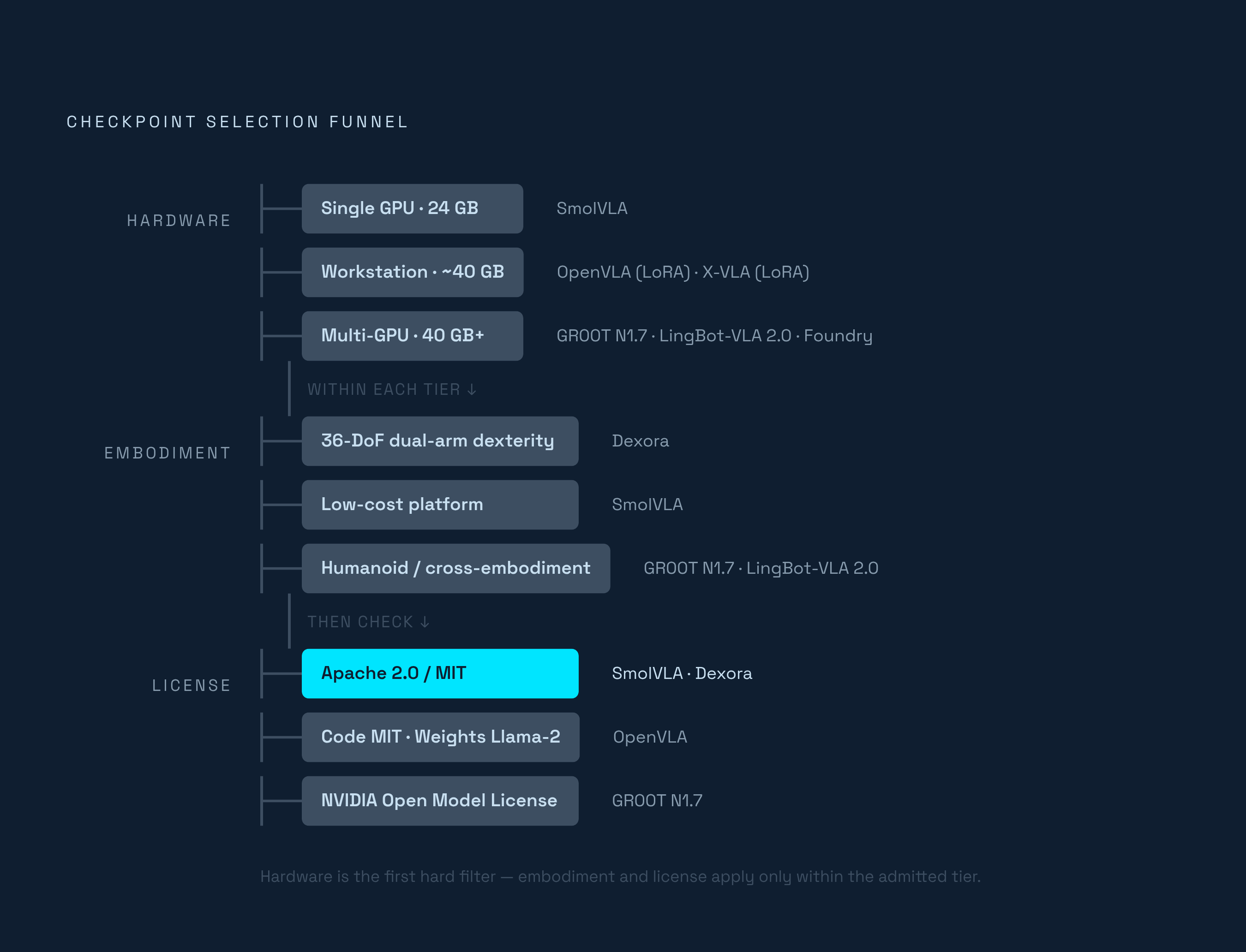
The practical selection process begins with hardware, then narrows by embodiment, licensing and data. For a single consumer GPU with 24 GB, SmolVLA is the specified option, with a modest demonstration set and training measured in hours. A workstation with up to approximately 40 GB VRAM supports OpenVLA with LoRA or layer-selective tuning, or X-VLA with LoRA. Multi-GPU or 40 GB+ VRAM configurations open the selection to GR00T N1.7 full fine-tuning, LingBot-VLA 2.0 and Foundry models.
Embodiment then distinguishes otherwise feasible candidates from one another. Dexora fits high-DoF dual-arm dexterity, while SmolVLA addresses low-cost robot platforms. GR00T N1.7 and LingBot-VLA 2.0 suit humanoid or cross-embodiment work at scale. For general manipulation with language grounding, OpenVLA's robot pretraining and X-VLA's soft prompts provide different starting points.
SmolVLA and Dexora offer permissive commercial terms, whereas OpenVLA requires attention to the distinction between its code and backbone licenses. GR00T N1.7 requires acceptance of NVIDIA's terms. Where pretraining auditability is required, Foundry provides the end-to-end-open option.
With fewer than a hundred demonstrations, the evidence supports choices with strong transfer, including OpenVLA with OFT or GR00T N1.7 with a frozen visual encoder, while FAN-guided regularization helps with the single-demonstrated-action constraint. For 100–500 demonstrations, LoRA or layer-selective adaptation on OpenVLA or X-VLA provides a practical route, while OFT's parallel decoding and action chunking improve the performance-compute tradeoff. Short compute budgets change that advice. The SmolVLA negative result supports avoiding added regularization or auxiliary supervision when there is insufficient training time to realize the benefit.
What is shifting at the frontier and what it means for practitioners choosing today
GR00T N1.7's EgoScale results show improved out-of-the-box dexterity and generalization before task-specific fine-tuning. That shifts attention toward the quality of the initial policy. If stronger pretraining continues to improve transfer and reduce demonstration requirements, larger checkpoints may become more competitive even with very small task datasets.
Foundry makes pretraining auditing possible, which is relevant where regulated or safety-critical deployment requires documented data provenance. VLAFlow makes controlled comparisons of pretraining objectives methodologically feasible. Together, these developments support decisions based on how a policy was trained, rather than treating benchmark success as the only available evidence.
Reinforcement fine-tuning leaves the adaptation choice open as well. For tasks with environment simulators, practitioners should treat it as a live option, while accounting for environment access and sample cost. FAN's applicability to both supervised and reinforced learning shows that useful recipe components can span that divide. This landscape is a snapshot of a fast-moving ecosystem, so the durable selection framework rests on hardware fit, embodiment, licensing, data and evaluation.
Sources
- VLAFlow: A Unified Training Framework for Vision-Language-Action Models via Co-training and Future Latent Alignment
Provided the analysis of training objectives — language supervision versus future latent alignment — used in the pretraining data strategy section.
- Finetuning Vision-Language-Action Models Requires Fewer Layers Than You Think
Supplied the layer-selective fine-tuning findings on representational redundancy and twin-layer removal in π₀ and GR00T-N1.5.
- Boosting Vision-Language-Action Finetuning with Feasible Action Neighborhood Prior
Provided the FAN-guided regularization approach using a Gaussian prior to address the single-demonstrated-action mismatch in manipulation fine-tuning.
- OpenVLA: An Open-Source Vision-Language-Action Model
Provided details on OpenVLA's pretraining on Open-X episodes, its LoRA adaptation results, and the ablation showing pretraining contributes beyond architecture alone.