VLA Inference Latency on Edge Hardware
Profiling edge hardware reveals bandwidth bottlenecks desktop benchmarks miss.
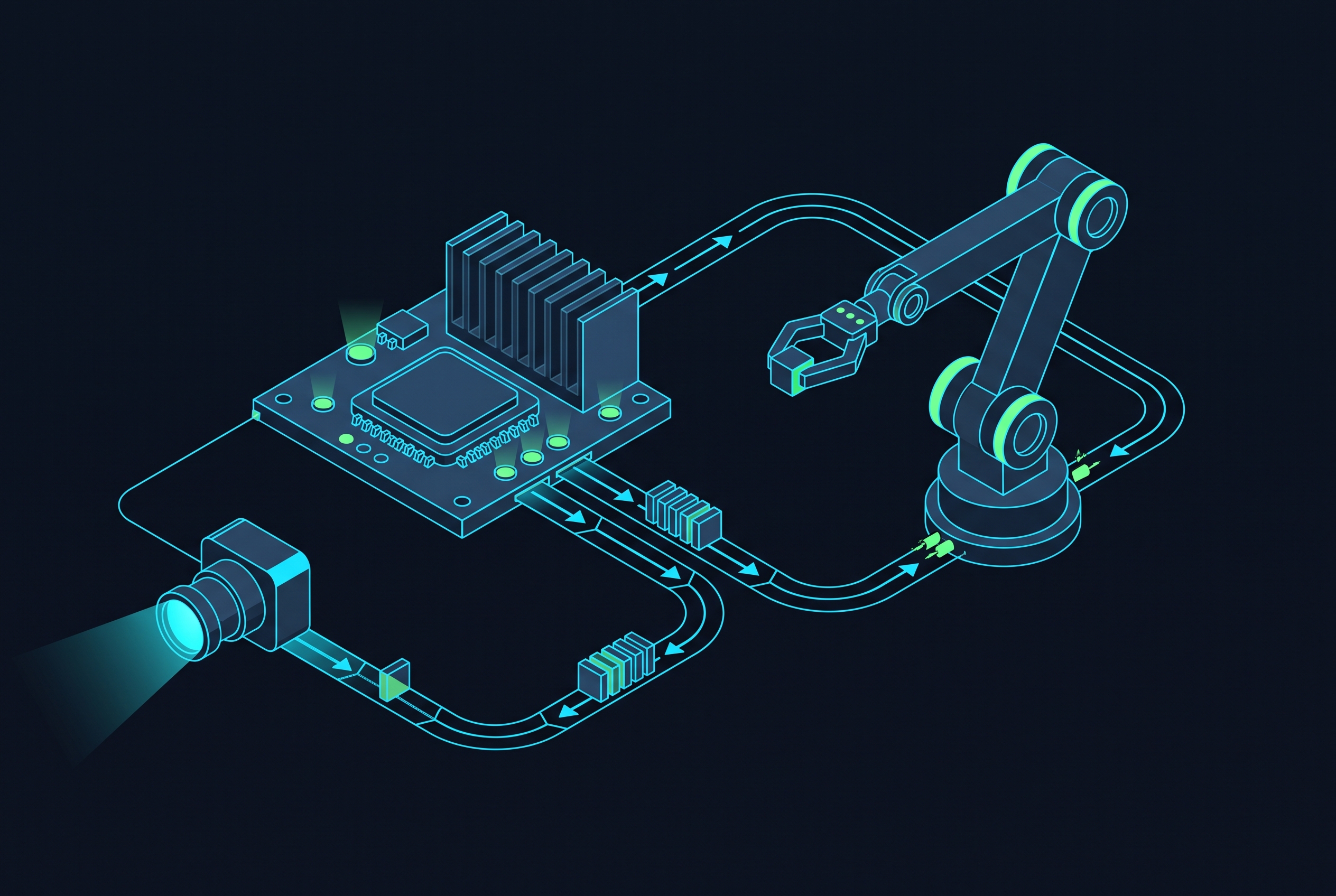
VLA inference latency on edge hardware is a layered deployment problem. How large the model is, how much memory bandwidth it has, and how it splits perception from action generation all affect how it handles runtime overhead and meets control requirements. Getting research performance to carry over to a robot starts with profiling the model, hardware, and task at hand before choosing an optimization based on its headline speedup.
Why edge hardware creates a fundamentally different inference problem than desktop benchmarks reveal
A benchmark shows how fast a model finishes inference, but a robot reacting to a moving object needs an answer before the scene changes. Those are different tests of useful performance. Vision-language-action models run in a closed loop, going through observation, inference, and action over and over. At 30 Hz, an inference delay spans control steps.
Zhou et al. (2026) note that most prior VLA evaluations rely on desktop-grade GPUs such as the NVIDIA RTX 4090. That practice obscures the trade-offs offered by heterogeneous edge accelerators and the constraints of placing computation on a robot. Latency is only one of those constraints. Mobile robots, humanoids, and last-mile delivery platforms must also stay within their acquisition-cost and energy budgets. Desktop inference results do not establish whether a model can meet all three requirements together.
The scale problem: why parameter count alone translates into a memory bandwidth wall on edge silicon
Large VLA models demand more memory bandwidth than current embedded and edge-AI silicon can supply for real-time operation. Their visual inputs alone have hundreds of vision tokens, each with hundreds of dimensions. Processing these high-dimensional embeddings means moving a lot of data in memory, even before the rest of the control loop runs. Even with compute to spare, the device falls short when data cannot reach it fast enough.
Autoregressive action decoding makes this mismatch especially severe because it generates actions token by token. Sapkota et al. note that this approach typically achieves only 3–5 Hz, far below the control rates manipulation tasks require.
Economic pressure makes that mismatch harder to avoid by selecting more expensive hardware. Zhou et al. cite the Unitree G1 as an example of humanoid robot prices reaching consumer-accessible levels. As robot acquisition costs fall, the pressure to avoid flagship GPU costs grows. Inference has to meet the robot’s needs within its hardware budget, which limits how much of a desktop configuration can fit onboard.
The two-phase inference pattern that makes edge underutilization worse than the numbers suggest
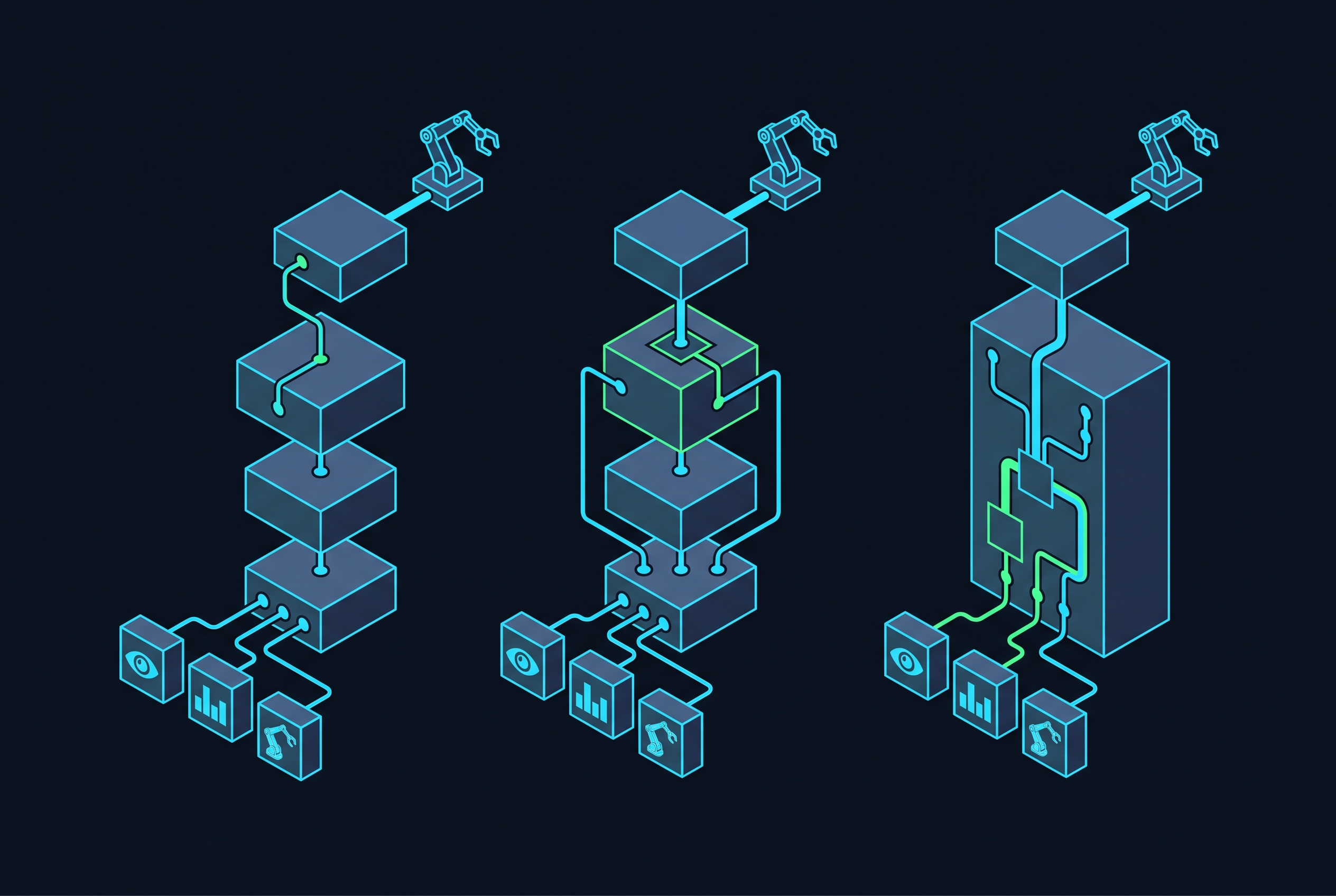
Zhou et al. use Roofline analysis and end-to-end profiling to identify a consistent two-phase pattern across mainstream VLA pipelines. A compute-bound vision-language backbone runs first, followed by memory-bound action generation. The backbone needs arithmetic throughput, while the action phase relies more on memory bandwidth. A platform well matched to one phase is therefore not necessarily well matched to the next.
During backbone execution, a device’s compute capability can be useful, but that same capability can sit underused when action generation becomes bandwidth-bound. In turn, hardware that handles memory-heavy work well may not run the backbone fastest. A single peak-throughput specification hides this transition. It describes capacity without showing how much of that capacity each phase can use.
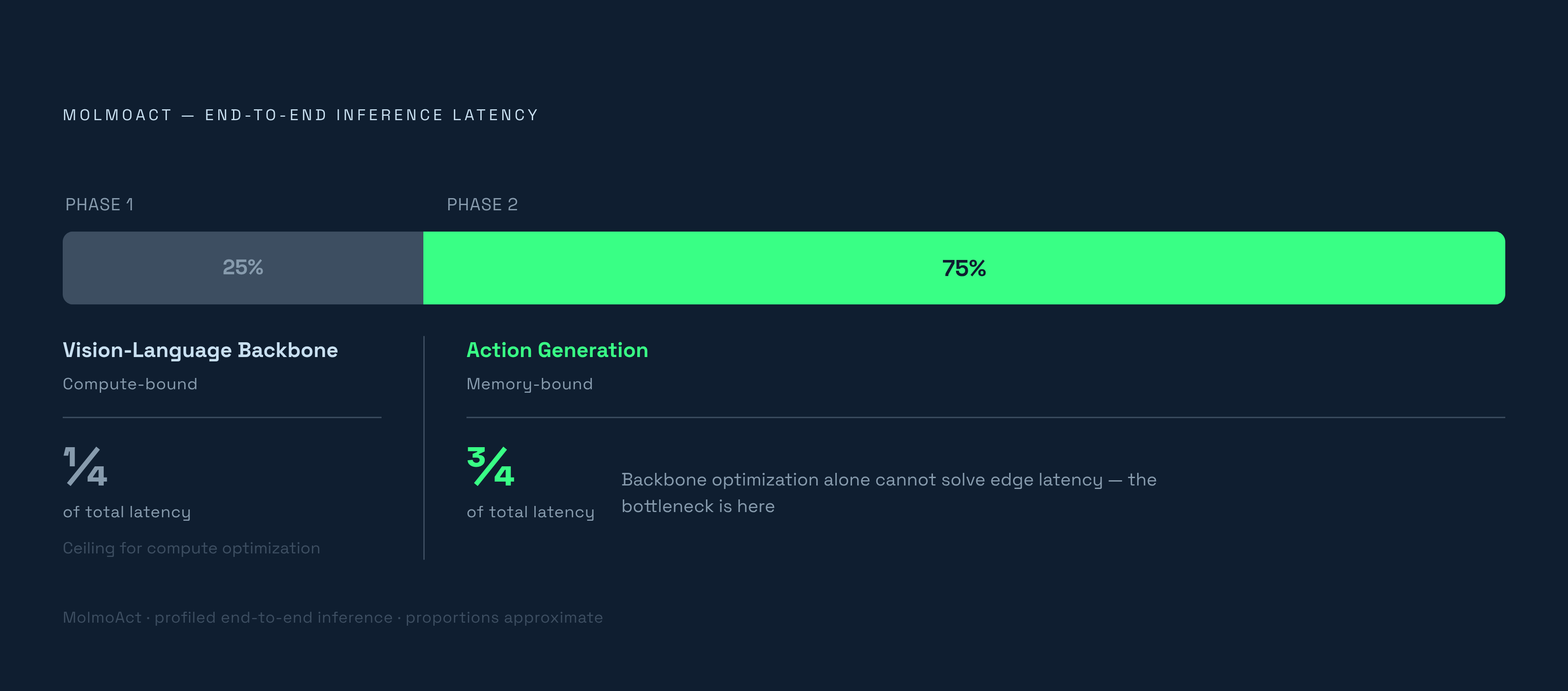
MolmoAct makes the consequence concrete. The researchers find that roughly three-quarters of its end-to-end latency comes from memory-bound action generation. Making the backbone use compute more efficiently can cut only a small share of the total delay. Optimization therefore depends on which resource the dominant phase is waiting for.
What the latency gap costs in practice: concrete hardware measurements on real edge devices
Cao et al. (2026) report that naive π₀.₅ inference on a Jetson Thor spans about 14 control steps at 30 Hz. The same model runs roughly six times faster on a desktop GPU. That gap separates inference that can support timely feedback from inference that leaves many control steps between observation and response.
Energy measurements expose a second deployment limit. The same study reports that a lightweight local predictor on Jetson Orin Nano takes 20.7 ms and 0.122 J per inference, while GR00T on an RTX A6000 takes 289.3 ms and 40.46 J. These configurations differ in both model and hardware. Nevertheless, the RTX A6000’s power budget is incompatible with battery-powered operation. For untethered humanoids, mobile manipulators, and delivery robots, latency and energy cannot be assessed independently.
Taherin et al. find that both action tokenization strategy and backbone size strongly influence throughput across edge and datacenter platforms. Memory footprint follows a different pattern. Backbone size primarily determines it, while action tokenization has negligible impact. A throughput measurement alone therefore cannot establish whether a model fits within the memory and energy constraints of an onboard system.
Action chunking as the most immediate lever: what it does and what it cannot fix
Action chunking improves effective inference rate by producing a sequence of actions rather than requiring a separate inference for every action. It is a genuine, widely adopted solution with no additional run-time cost. Several control steps can use one prediction. This makes chunking the first and cheapest lever for reducing how often the full VLA must run, without requiring the underlying inference pass to become faster.
The trade-off is reduced temporal resolution. While a chunk executes, the robot follows a plan based on an earlier observation. That open-loop exposure is safe in static environments but degrades performance when the scene changes. Cao et al. show VLA-ULAP exceeding π₀.₅’s success rate on latency-aware dynamic tasks because it reduces this exposure. Effective action throughput and responsiveness are therefore different properties.
Chunking also leaves the bandwidth and phase-mismatch problems intact. Each full inference still encounters the same hardware constraints, even if it supplies more actions. Nor is chunk length a deployment-time setting that can simply be increased on an already-trained model. It is a training-time decision and requires retraining to change. Its value is substantial, but it does not remove the need for model and systems optimization.
Model compression approaches and what they actually recover on edge silicon
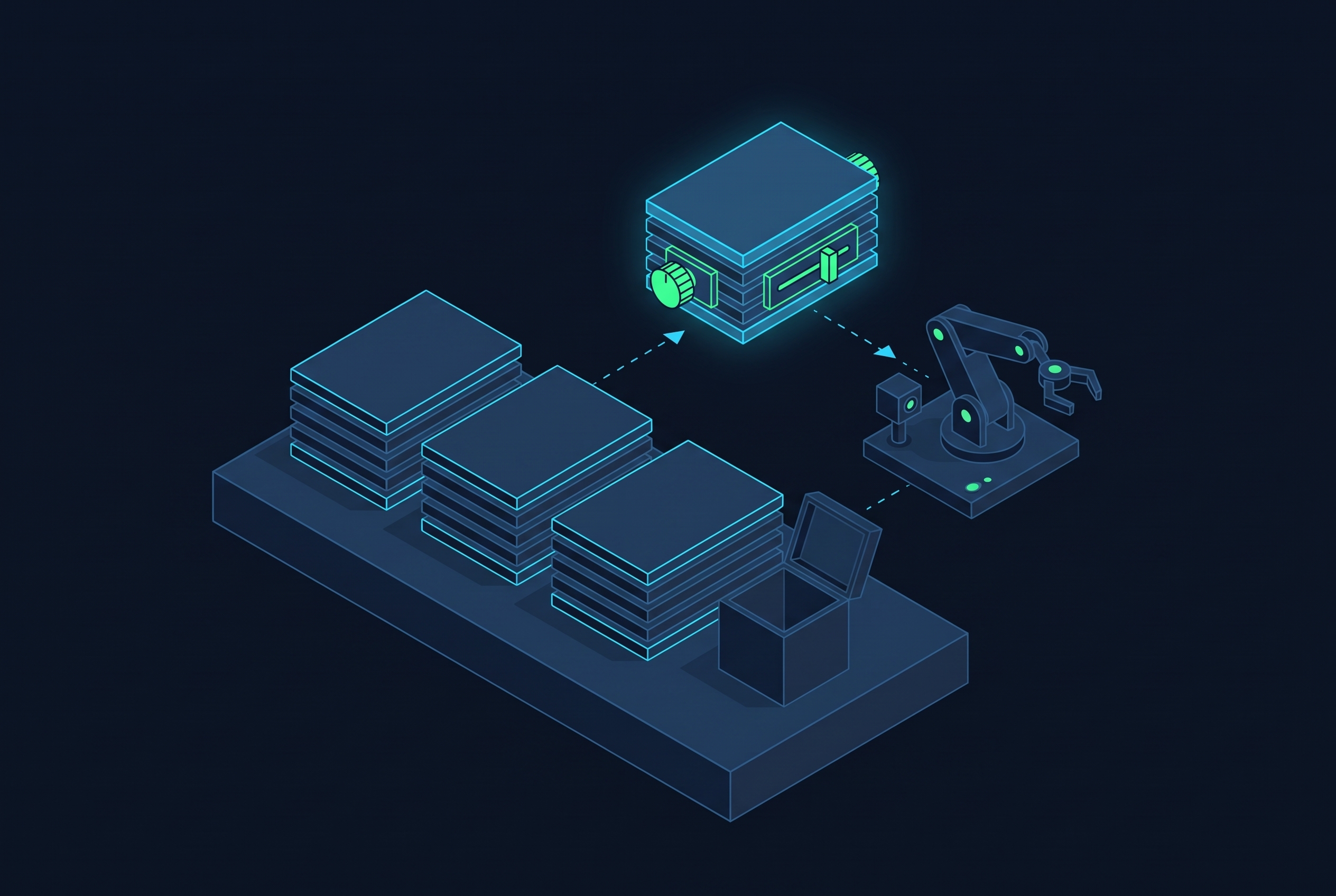
Compression cuts how much memory the model needs, while lightweight architectures cut how much computation the model has to do. These approaches can recover substantial latency, but their accuracy costs are not monotonic. The outcome depends on the representation, calibration, and part of the pipeline being changed.
BitVLA uses 1.58-bit quantization and achieves substantially higher throughput than OpenVLA-OFT+ while remaining faster than π₀. Its vision encoder’s memory footprint shrinks dramatically with only a small absolute drop in average accuracy. Nguyen et al. (2026) demonstrate BitVLA completing all 200 LIBERO-Object episodes on an 8 GB Jetson Orin Nano. That result places this class of model on a memory-constrained device previously considered out of scope.
ActQuant (2026) demonstrates action-aware, sub-4-bit quantization without catastrophic accuracy loss. QuantVLA (CVPR 2026) instead uses scale-calibrated post-training quantization at W4A8, with 4-bit weights, and can match or exceed full-precision baselines. These results broaden the prospects for NPU and microcontroller deployment. However, the two-phase structure prevents uniform compression from being a dependable latency strategy. Because the backbone and action expert have different arithmetic intensity profiles, compressing both uniformly can worsen the memory-bound phase while providing little latency benefit in the compute-bound phase.
Runtime and serving infrastructure as a latency multiplier independent of model weight
The inference stack introduces another source of delay that model compression does not address. A purpose-built runtime can make inference faster without changes to model architecture or training. The weights are not the whole execution system. Runtime and kernel choices determine how well their operations use the available hardware, including the transition between compute-heavy and memory-heavy phases.
Nguyen et al. introduce vla.cpp as a unified C++ inference runtime for eleven VLA models, with no PyTorch dependency for model execution. It runs SmolVLA at 28.16 ms per environment step, compared with 223.96 ms for the PyTorch reference. That is a 7.95× speedup at essentially the same peak VRAM.
Kernel selection also interacts with compression format. A ternary tensor-core kernel in the runtime accelerates BitVLA client inference by 4.0–4.6× over the CUDA-core baseline on RTX 3060 and AGX Orin. Such gains must be evaluated per architecture because different phases dominate different pipelines. Numerical behavior also needs attention. The study’s SmolVLA case links positional-index precision in the inference stack to gripper commands and task success, exposing a safety-relevant artifact invisible in desktop benchmarks.
Architectural approaches that split the two-phase problem across deployment boundaries
Zhou et al. describe a shift toward dual-system designs that separate high-level perception and reasoning from low-level, high-frequency control, exemplified by Hi-Robot, π₀, and GR00T. The boundary can separate edge and cloud hardware or fast and slow subsystems on one robot. This permits different resources to serve different requirements. It also introduces coordination costs.
RAPID demonstrates the potential of edge-cloud layer splitting with 222.9 ± 11.4 ms end-to-end latency, compared with 782.5 ms for edge-only VLA execution. It offloads 11.8 GB to the cloud while retaining a 2.4 GB edge-side footprint. Cloud results can nevertheless arrive stale. Moving computation does not by itself preserve observation freshness.
Peng et al.’s CloudEdgeVLA treats temporal misalignment as a representation-learning problem. Its cloud VLA encodes delayed observations into slowly varying task features, while a lightweight edge head combines the latest available cloud feature with current local vision. It still has strong success rates across four LIBERO suites with a 40-step uniform-delay window. A separate approach, Huixi Intelligence’s RhinoVLA (2026), uses algorithm–system co-design to reach 11.69 Hz on Huixi R1. It meets a 10 Hz closed-loop target at performance comparable to π₀.₅, showing that deployment architecture can reshape the trade-off.
Why minimizing per-step latency is not always the right objective
The TISED framework in “The Speedup Paradox” (2026) finds that faster embodied policies can take longer to finish a task. Lightweighting produces non-monotonic task-level behavior. On static tasks, mild optimization cuts the time needed to finish, but aggressive optimization can hurt action quality enough that the robot needs many more steps. The extra steps outweigh the faster inference. Per-step latency then improves while the useful outcome worsens.
Dynamic tasks can reverse that relationship. A faster but less precise reaction can outperform a slower, more accurate one because it uses fresher observations. In that setting, reducing inference delay can outweigh the loss of action precision. The optimization target therefore depends on what changes during execution as well as how accurately the model predicts an action in isolation.
A latency target calibrated on one device can be harmful on another because the balance between action quality and observation freshness shifts. Zhou et al. accordingly organize their leaderboard around Cost, Energy, and Time jointly. Edge devices sized to the task can meet control-rate constraints at lower cost and with less energy than flagship GPUs. Minimizing milliseconds alone would miss that deployment objective.
What the current state of the field means for practitioners choosing a deployment path today
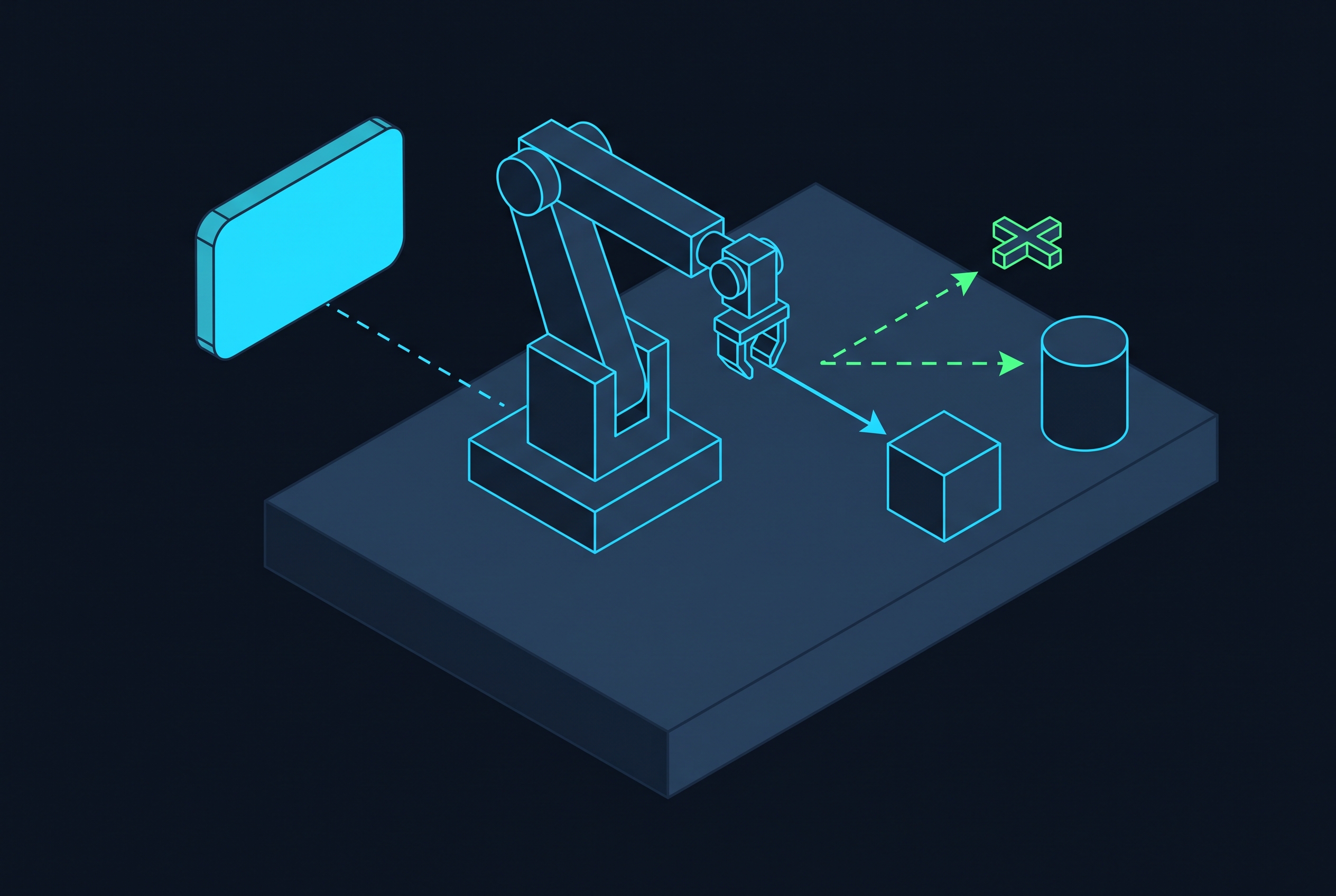
Choosing an optimization requires profiling the dominant inference phase. An action-expert-bound model responds differently to quantization and pipeline splitting than a backbone-bound model. That diagnosis needs to be checked against how well the model does the task, including whether precision or fresh observations matter more in that environment. Device constraints complete the picture. Latency measurements without memory, energy, and cost leave the deployment decision incomplete.
Practitioners need to plan for action chunking at training time, then choose a runtime to get further gains without changing model architecture or training. Compression and architectural redesign need accuracy tests for each task. ActQuant and QuantVLA make low-bit deployment increasingly credible, but their distinct quantization approaches do not establish a universal operating point. Processing-in-memory and high-bandwidth memory are projected as the next hardware frontier for very large edge models, but are not yet available in production edge systems.
Tooling choices will also need revisiting. ICLR 2026 has vastly more submissions tagged “vision-language-action” than earlier cycles, reflecting a rapidly changing systems landscape. A benchmark or runtime selected today may need reassessment within a product cycle.
Sources
- vla.cpp: A Unified Inference Runtime for Vision-Language-Action Models
Provided details on the vla.cpp runtime, including its 7.95× speedup over PyTorch, SmolVLA latency figures, and the ternary tensor-core kernel acceleration of BitVLA.
- VLA-ULAP: Interleaving Cloud VLA Calls with Ultra-Lightweight Local Action Prediction at the Edge
Provided the 3–5 Hz autoregressive action decoding rate and the VLA-ULAP system's performance on latency-aware dynamic tasks compared with π₀.₅.
- Vision-Language-Action Models: Concepts, Progress, Applications and Challenges
Cited for the observation that autoregressive action decoding in VLA models typically achieves only 3–5 Hz, far below manipulation control rates.
- Cross-Platform Scaling of Vision-Language-Action Models from Edge to Cloud GPUs
Provided findings on how action tokenization strategy and backbone size influence throughput and memory footprint across edge and datacenter platforms.
- Characterizing Vision-Language-Action Models across XPUs: Constraints and Acceleration for On-Robot Deployment
Provided Roofline analysis identifying the two-phase compute-bound/memory-bound pattern, MolmoAct latency breakdown, and concrete hardware measurements including π₀.₅ on Jetson Thor and energy figures.
- Latency-Tolerant Cloud-Edge Collaborative Vision-Language-Action Models via Emergent Representational Specialization
Provided the CloudEdgeVLA approach where cloud VLA encodes delayed observations into slowly varying task features combined with a lightweight edge head, with results across LIBERO suites.