Agricultural Robot Deployment for Selective Harvesting
Robots can perceive ripe fruit but struggle to pick it without damaging delicate crops.
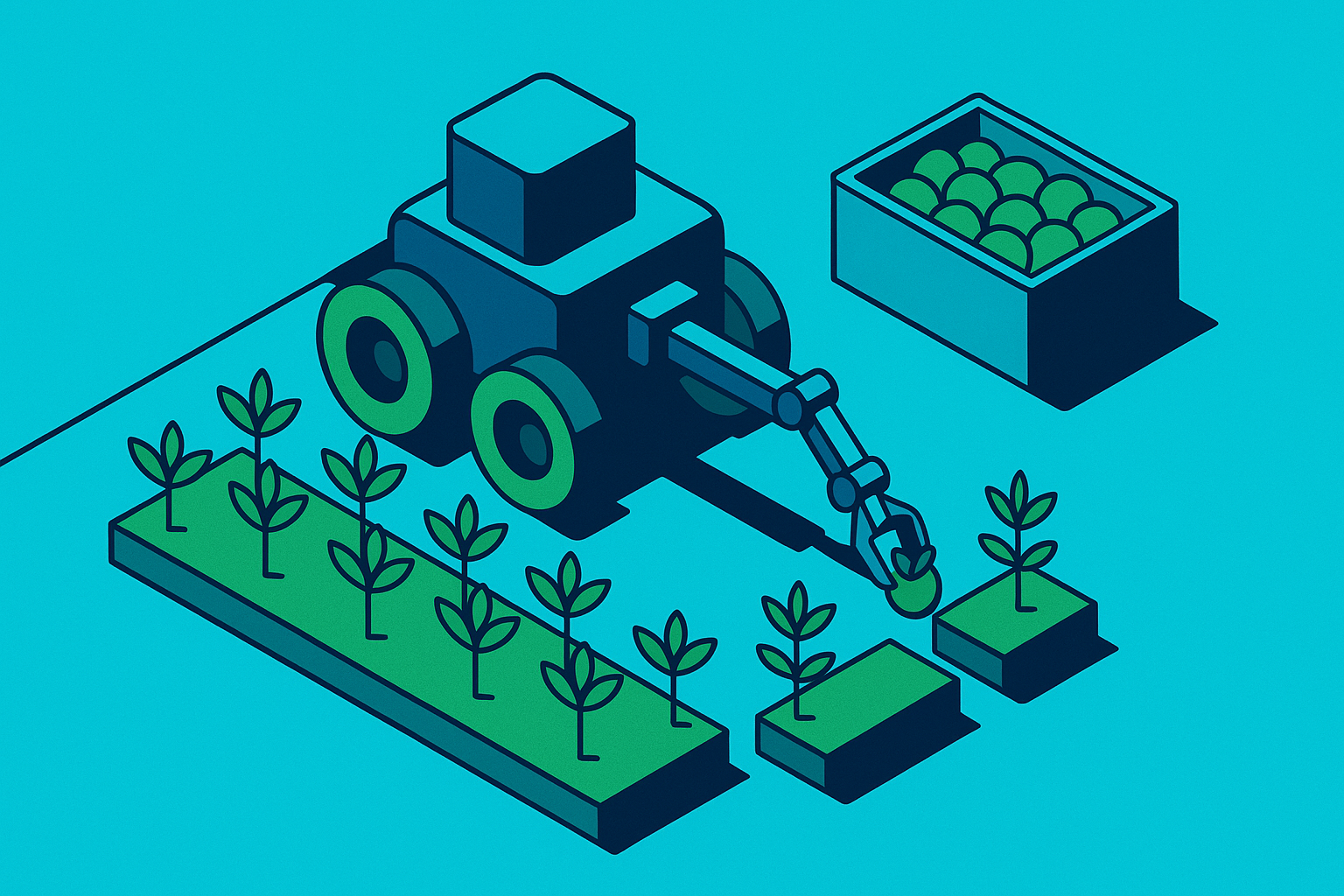
Selective harvesting is a labor problem before it is a robotics problem, and the two cannot be separated when evaluating deployment. The crops that most need mechanical help are precisely the ones that resist the kind of automation already proven in grain and row-crop agriculture.
Why selective harvesting resists simple automation
Wheat and corn ripen more or less together across a field, so grain harvesting scaled by letting a combine run on a fixed schedule. Strawberries, table grapes, peppers, and tree fruit don't cooperate that way. A single plant can carry ripe, nearly ripe, and green fruit at once, so every pass through a row needs a decision about each individual piece of produce, not a blanket cut across the whole field. That decision, made instantly and correctly by a human hand, is what automated steering systems and timed implements were never built to do.
Farm workforces in developed countries are aging out of the job, immigration policy has tightened the pipeline of seasonal labor in major producing regions, and growers in those regions routinely report leaving a meaningful share of their crop unpicked simply because there aren't enough hands to bring it in before it spoils, a structural shift in labor supply that a good year cannot reverse.
The economics make the stakes concrete. In crops like strawberries, the selective harvesting step alone accounts for more than a quarter of total production costs. A missed picking window doesn't just cost a day of wages. The fruit itself is gone, and if the crop is a high-value specialty one, that lost window hits revenue per acre hard. That combination, rising cost pressure on one side and a labor pool that keeps shrinking on the other, is why selective harvesting has become the testing ground for a new generation of agricultural robots, and why the engineering challenge involved is so much harder than it looks from the outside.
The four technical layers every selective harvesting robot must solve
Peer-reviewed review literature on selective harvesting robots treats the problem as a systems challenge spanning perception, grasping and cutting, motion planning, and control, and progress in any one of those areas is bounded by what the others can support. A robot with excellent vision but a clumsy gripper fails just as surely as one with a strong gripper and poor eyesight.
The perception layer handles fruit detection, ripeness classification, and spatial tracking, and it has to do all of that under shifting light, partial occlusion by leaves and stems, and the color variation that comes with different cultivars of the same crop. The end-effector layer covers whatever touches the fruit itself, whether that's a soft gripper, a suction cup, or a small cutting blade, and it has to detach the target without bruising it, a particularly unforgiving constraint for delicate berries. The motion planning layer governs how the arm moves from a detected target to a successful grasp in three-dimensional space, threading around leaves and neighboring fruit while keeping the whole cycle fast enough to matter economically. The field integration layer covers everything else a working robot needs: moving itself between rows, managing the logistics of harvested fruit, operating safely near people, and holding up under outdoor weather and terrain.
Each of these layers fails in its own particular way, and a harvesting system is only as commercially viable as its weakest one. That's why framing robotic harvesting adoption as a single "buy or don't buy" technology decision misleads growers. Which of the four layers a given system has actually solved for a given crop, and which it hasn't, is what matters.
What perception systems can do in a field
Perception has made the most visible progress, largely because computer vision has benefited from advances built for industries far larger than agriculture. But how well a vision system performs in a research lab says little about how it performs in a field, where conditions are never as cooperative as a curated dataset.
Occlusion is the hardest unsolved problem in this layer. Leaves hide ripe fruit, stems tangle it, and it clusters against unripe fruit that a camera has to learn to ignore. Pick success rates in research settings reflect that difficulty directly: they run low in complex cluster scenarios and climb to near-perfect when a single ripe fruit sits in the open with nothing blocking the view. That spread between the easy case and the hard case is large enough that no grower can treat a lab success rate as a promise of field performance.
Color, size, and shape differ fruit to fruit and variety to variety, so a vision system has to generalize across a cultivar. Newer model architectures handle that generalization better than older ones, but a grower can plant many commercial varieties, and not all of them are covered yet.
One genuine advance tackles raw processing speed in perception systems. Research from the University of Lincoln looked at edge computing over 5G networks, and found that if you move perception workloads off a robot's onboard embedded hardware and onto edge servers, processing speed jumps. That matters because real-time fruit detection is a data-heavy task, and offloading it means a robot doesn't need to carry heavier, more expensive compute hardware just to see clearly in real time. It's an architectural fix for a bottleneck that has nothing to do with how smart the vision model is and everything to do with where the computation happens.
How end-effector design shapes what a robot can harvest
Perception only matters if the hardware that touches the fruit can act on what it sees, and the mechanism built to do that locks a robot into a narrow range of crops instead of serving as a general-purpose harvesting tool. A gripper engineered for strawberries is a different machine, mechanically and conceptually, from one built for apples or tomatoes.
Berries demand detachment without bruising, which pushes designers toward soft grippers, vacuum suction, or some hybrid of the two, and each of those approaches fails differently when fruit is wet, oddly shaped, or packed into a tight cluster. Tree fruit poses a different mechanical puzzle entirely: an apple-picking end-effector needs enough grip force to pull the fruit free of the stem while controlling the angle of that pull carefully enough not to damage the spur the fruit grew from, since damaging the spur affects next year's yield, not just this one.
Greenhouse tomato production offers a more forgiving geometry, and that structure is what makes a system like the DENSO/Certhon Artemy robot work. Artemy launched commercially in May 2024, and it uses dedicated LEDs to detect both the fruit cluster and the peduncle, the stem connecting the truss to the plant, so it can harvest cherry truss tomatoes with enough precision to also manage automatic lane changes and automatic crate replacement as part of its normal operating cycle. None of that would be possible in an open field with the wind, uneven rows, and unpredictable canopy structure that outdoor crops present.
Some crops push designers toward more than one arm. Peer-reviewed work on multi-arm coordination treats the problem of getting several arms to cooperate, and to maximize the harvest they bring in together, as a reinforcement-learning problem. Dogtooth's two-arm strawberry robot is a commercial reflection of that research: more arms per unit mean more picks per pass, provided the arms can be coordinated without colliding or duplicating effort. The HortiBot system, a multi-arm platform built for sweet peppers and documented in research literature, makes the same point from a different crop: arm configuration and gripper geometry have to be designed together around the specific shape of the plant's canopy, because a system built for one crop's architecture rarely transfers cleanly to another's.
Motion planning under field conditions and the speed gap it creates
Even with reliable perception and a gripper matched to the crop, a robot still has to move from detection to grasp fast enough to be worth deploying, and this is where the gap between laboratory performance and commercial viability becomes hardest to ignore. If a system trades picking speed for success rate, most growers can't absorb that cost.
The range is wide. Strawberry picking takes around 10 seconds per fruit under typical conditions, but in complex cluster scenarios it can stretch past a minute, and at that upper end the whole system becomes commercially unviable against current labor costs. A human picker simply outworks a robot stuck at the slow end of that range, no matter how precise the robot's final grasp turns out to be.
The underlying tension is mechanical and unavoidable: a system that moves cautiously, exploring its surroundings carefully to avoid bruising the fruit or knocking into a neighboring stem, achieves a high success rate but low throughput. A system tuned for speed accepts more bruising and more dropped fruit in exchange for faster cycles. Neither extreme satisfies a commercial operation on its own, and most of the engineering effort in this layer goes toward narrowing that trade-off.
The E5SH system, developed at the University of Lincoln, addresses part of this problem by offloading semantic segmentation work to an edge server over 5G, which clears up the perception bottleneck without adding latency. Localization, 3D mapping of the picking space, and the action planning that governs the arm's actual movement still run on the robot's own onboard compute. That's a meaningful architectural step forward, but it remains a research-scale demonstration, not a fielded commercial product, and motion planning, which decides how fast an arm can move without damaging anything, hasn't been solved by moving the vision workload elsewhere.
How 24-hour operation and semi-autonomy change the commercial calculus
The speed gap looks less severe measured against a full day than against a single pick. A robot that works slower than a human but never stops working changes the comparison entirely, and this is the clearest counterargument to treating the speed gap as disqualifying.
Dogtooth's two-arm strawberry robot picks at roughly half the rate of a human worker per hour, but it runs continuously, day and night, without breaks, shift changes, or fatigue. When you measure it across a full 24-hour cycle, continuous operation produces much higher total output than the per-hour comparison alone would suggest. The economics shift further when one human operator manages several robots at once instead of running one machine full time, because that ratio is what sets labor cost per unit harvested.
Most commercial deployments today run in a semi-autonomous mode rather than full autonomy, and that segment commands the largest share of the market. Growers tend to want to keep control over the decisions that matter most, like which rows to prioritize or when to pull a machine for maintenance, while letting automation handle the repetitive work of the pick itself. Full autonomy remains the long-term goal across the industry, but it isn't yet the commercial norm, and most of the revenue in this space today comes from systems built around that human-in-the-loop model.
Dogtooth's own trajectory shows what a realistic commercial ramp looks like: introduced commercially in the UK in 2025, with unit availability scaling steeply in the time since, including a recent installation at Dyson Farming, one of the UK's larger farming enterprises. The company secured more than £14 million in growth capital in July 2026 to expand deployment across the UK and into international markets, and investors say that capital reflects confidence in the 24-hour operating model specifically.
That model has real limits. The entire 24-hour offset argument assumes consistent mechanical uptime and a field geometry predictable enough for a robot to navigate without help. Wet weather, uneven outdoor terrain, and the logistics of turning a machine around at the end of a row still require a human to step in, and that need caps how much continuous operation a grower can actually count on in practice.
Where deployment makes economic sense today
None of this adds up to a general case for replacing human pickers. Robot ROI in selective harvesting depends entirely on which crop is being picked and how tight the local labor market is, and the strongest investment case appears where fruit value is high and seasonal labor is the least reliable, not as some universal substitute for people.
Commodity row crops like corn, wheat, and soybeans don't fit this picture. Margins there are too thin to justify the cost of a selective harvesting robot, and that's not where the technology is headed. Precision spraying and weeding already make economic sense in those crops, but picking does not, because grain harvesting was mechanized decades ago using equipment built for uniform ripening, and that equipment remains cheaper and faster than any robotic alternative could be for these crops.
Berries and other high-value specialty crops sit at the other end of the spectrum. Agrobot's E-Series strawberry robot remains in development, without a published price or general availability as of its current stage, and it's aimed squarely at operations paying H-2A or equivalent visa labor costs, where seasonal workers may simply not show up in the numbers needed. If a grower already pays those visa labor rates, the return on a robotic alternative improves every time labor costs climb. As of May 2025, Agrobot does offer its E-Series strawberry-picking robots, built around computer vision and AI, focused exclusively on strawberries, giving growers in that segment a commercial option to evaluate directly.
Greenhouses and other controlled-environment operations offer the most favorable conditions a harvesting robot can ask for. Weather, pests, and inconsistent lighting are engineered out of the equation, which allows near-continuous operation, and indoor farming is the fastest-growing end-use segment in the harvesting robot market as a result. The Agroz Robotics deployment of UBTECH's Walker S humanoid robot in Malaysian vertical farming operations shows how far that controlled environment extends a robot's mandate: the same platform handles seeding, monitoring, harvesting, and crop optimization together, a breadth of task that open-field robots can't yet attempt.
Tree fruit sits in between, still mostly at the testing stage. A dual-arm apple harvesting system underwent commercial-orchard testing during the 2025 season, in Michigan from August through October and in Washington State in October, and that data is preliminary. It does show where orchard ROI testing is concentrated right now, so if you're a grower evaluating tree-fruit robotics, read it as an early signal, not a proof point.
Three questions determine fit for any grower considering this investment: what crop is being picked, what the local labor costs actually run, and how controlled the growing environment is. Those three variables decide whether the economics work, more than any single robot's specs do.
What the 2026 deployment landscape shows about remaining gaps
The 2026 Crop Robotics Landscape catalogs companies working across nearly every task segment in agricultural automation, but the sector is still shifting, not settling. A high rate of both company exits and new entrants in the same period points to a field still searching for proven approaches rather than consolidating around a handful of winners.
Geography tells its own part of the story. Europe accounts for half of all identified companies in the landscape, with innovation clusters concentrated in the Netherlands, Germany, France, and Italy. One country leads all others by company count, and within that country, a single region accounts for a large share of the total, reflecting its concentration of both specialty-crop agriculture and robotics engineering talent.
Harvesting robots specifically continue to trail other segments of crop robotics in commercial maturity. Production deployments already exist for mushroom harvesting and other indoor systems, and promising field harvesters are emerging across several crops, but as a segment, harvesting lags behind navigation, spraying, and weeding robots, all of which have reached a more settled state of commercial reliability. Tree-fruit picking illustrates the pattern most starkly: robots aimed at that task have been described as nearly commercial for the better part of a decade, and genuine engineering progress shows up in named systems year after year, yet commercial reliability across the full range of variable field conditions remains the problem none of them has fully closed. That gap, between visible technical progress and dependable field performance, is the honest state of selective harvesting robotics heading into the rest of the decade.
Sources
- Optimising robotic operation speed with edge computing over 5G networks: Insights from selective harvesting robots
- Towards Autonomous Selective Harvesting: A Review of Robot Perception, Robot Design, Motion Planning and Control
- HortiBot: An Adaptive Multi-Arm System for Robotic Horticulture of Sweet Peppers